
Top 10: AI Applications in EVs
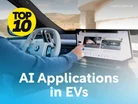
What if artificial intelligence could redefine how every electric vehicle learns, drives and connects?
From autonomous perception to predictive maintenance and energy‑smart charging, AI is reshaping how EVs move, charge and think.
Machine learning powers safer driving, longer battery life and seamless in‑car experiences, while data‑driven manufacturing and fleet optimisation improve performance and efficiency across the value chain.
As vehicles become more intelligent, connected and adaptive, the question is: which innovations are leading the charge?
EV Magazine has listed 10 of the top AI applications in EVs.
10. Autonomous Driving & ADAS
First used: 1986
Top three companies: General Motors, Tesla and BMW
First car involved: Mercedes van
CEO of Mercedes Benz: Ola Källenius

AI is transforming autonomous driving and advanced driver assistance systems (ADAS) into one of the top AI applications in EVs.
Through end-to-end AI models, vehicles can now process perception, prediction and planning simultaneously, improving responsiveness and safety.
Synthetic data enables faster, broader training for complex road scenarios, while generative AI enhances driver monitoring and human–machine interaction.
Edge AI is increasingly used to execute models directly in vehicles, reducing latency, improving privacy and supporting safer, more efficient autonomous transport development.
9. Predictive Maintenance
First used: 1968
Top three companies: BMW, Toyota and Ford
First car involved: Volkswagen
CEO of Volkswagen: Oliver Blume
Predictive maintenance is a standout EV AI use case, using telematics and analytics to forecast failures, schedule repairs and maximise uptime.
It drives profitability in rentals, subscriptions, car-share, leasing and micro-leasing by reducing breakdowns, improving customer experience and protecting residual values.
Models track battery, motor and tyre health, supported by simulation and digital twins.
ES&P Global gives the example of ZF’s TempAI to improve powertrain thermal prediction by more than 15% and unlock 6% peak power.
Challenges include data governance, cybersecurity, updates and organisational change.
8. Battery Management Systems
First used: 1912
Top three companies: Panasonic, LG Energy Solutions and CATL
First car involved: Cadillac
CEO of Panasonic: Yuki Kusumi
AI-powered battery management systems (BMS) are central to EV performance.
Machine learning improves state-of-charge and state-of-health estimation, predicts remaining useful life and models degradation to optimise safety, range and lifespan.
Algorithms such as XGBoost and LSTM, plus electrochemical impedance spectroscopy, enhance accuracy.
Physics-based models with selective AI, cloud and IoT connectivity enable remote updates and predictive analytics, while cybersecurity hardens connected BMS.
Benefits include faster charging, better thermal control, lower warranty costs and support for reuse, recycling and standardisation globally.
7. Smart Energy Management & Range Optimisation
First used: 1997
Top three companies: Polestar, BYD and Hyundai
First car involved: Toyota Prius
CEO of Polestar: Michael Lohscheller
AI-driven smart energy management is a top EV application, coordinating charging, storage and sales to the grid for lower costs and longer range.
Platforms like Ayesa’s GridPilot use virtual power plants (VPP) to aggregate solar, stationary batteries and EVs, forecast availability and demand, then schedule off‑peak charging and enable vehicle‑to‑grid (V2G) revenues.
Fleet and home tools add bill-plan recommendations, demand forecasting, trip planning and battery diagnostics.
Outcomes include higher asset utilisation, reduced infrastructure downtime, improved grid stability and driver experience.
6. Intelligent Charging and Grid Integration
First used: 1990s
Top three companies: Nissan, Tesla and Ford
First car involved: AC Propulsion (prototype)
CEO of Nissan: Ivan Espinosa

AI is revolutionising intelligent EV charging and grid integration by managing when and how vehicles draw or supply power.
Smart chargers use AI to analyse demand, prices and grid capacity, scheduling charging during off‑peak or renewable-rich periods to lower costs and reduce grid stress.
Algorithms balance loads, predict faults and optimise fleet or route charging.
Vehicle‑to‑grid (V2G) systems enable EVs to return energy during peaks, enhancing stability.
Together, AI, smart charging and V2G transform EVs into dynamic assets supporting a resilient energy ecosystem.
5. Fleet Management & Predictive Analytics
First used: 1980s
Top three companies: General Motors, BMW and Toyota
First car involved: General Motors (1990s)
CEO of General Motors: Mary Barra
AI-driven fleet management and predictive analytics are transforming mobility.
Bosch leverages connected vehicle data to deliver real-time insights, enabling fleets to monitor performance, predict faults and minimise downtime.
Machine learning models optimise maintenance schedules, routing and energy use across electric and traditional fleets, reducing costs and emissions.
Solutions like Battery in the Cloud, Digital Fuel Twin and energy prediction tools enhance efficiency, safety and compliance.
Predictive maintenance, secure charging and data intelligence help fleets achieve maximum uptime, sustainability and long-term value.
4. Manufacturing Optimisation
First used: 1913
Top three companies: Tesla, BMW and Volkswagen
First car involved: Ford
CEO of Ford: Jim Farley
AI is revolutionising automotive manufacturing by optimising every stage from design to production.
Machine learning models analyse sensor data to predict equipment failures, streamline supply chains and enhance precision in assembly lines.
Generative AI accelerates R&D through virtual prototyping and material discovery, while edge and cloud AI enable real-time decision-making and adaptive quality control.
In EV production, AI improves battery chemistry, predicts thermal issues and optimises component performance.
Together, these technologies reduce waste, lower costs and enhance safety, creating agile, data-driven manufacturing ecosystems that boost productivity and shorten time-to-market for next-generation vehicles.
3. Personalised In-Car Experience
First used: 2010s
Top three companies: Tesla, Mercedes-Benz and Aston Martin
First car involved: BMW
CEO of Aston Martin: Adrian Hallmark

AI is redefining the personalised in-car experience by transforming vehicles into adaptive, intelligent companions.
Through machine learning and generative AI, systems learn driver habits, moods and preferences to tailor routes, climate, music and infotainment in real time.
Voice and gesture recognition enable natural interaction, while edge AI ensures low-latency responses and enhanced privacy.
Automakers use these insights to build software-defined vehicles offering seamless digital services, predictive maintenance and immersive entertainment.
The result is a safer, more intuitive and emotionally engaging driving experience that strengthens brand loyalty.
2. Safety Enhancements
First Used: 1998
Top three companies: Volvo, Audi and General Motors
First car involved: Toyota
CEO of Audi: Gernot Döllner

AI is driving major safety enhancements across the automotive industry, transforming how vehicles sense, react and prevent accidents.
Advanced driver assistance systems (ADAS) powered by machine learning and computer vision analyse real-time data from cameras, radar and lidar to detect hazards, apply brakes, or adjust steering before collisions occur.
Deep learning models improve accuracy in pedestrian, cyclist and obstacle recognition, even in poor visibility.
In-cabin AI monitors driver behaviour, detecting fatigue or distraction to trigger timely alerts.
Predictive analytics anticipate component failures, reducing mechanical risks, while edge AI ensures rapid response with minimal latency.
Generative AI enhances virtual crash testing and safety simulations, accelerating vehicle design and validation.
These integrated systems not only minimise human error, the cause of most road accidents, but also lay the foundation for fully autonomous driving.
Collectively, AI-powered safety technologies are redefining road safety standards, protecting passengers and creating a smarter, more resilient driving environment.
1. Navigation and Route Planning
First Used: 1981
Top three companies: BMW, Volkswagen and Stellantis
First car involved: Honda Electro Gyro-Cator
CEO of Stellantis: Antonio Filosa

Artificial intelligence is redefining EV navigation and route planning, making every journey smoother, faster and more efficient.
Intelligent systems now combine real‑time data on traffic, terrain and charging infrastructure to calculate the most energy‑optimised routes based on vehicle type, battery status and driving behaviour.
Platforms such as Octopus Electroverse and Google Maps enhance convenience by showing live charger availability, suggesting ideal stops and filtering options by plug type or charging speed.
Sophisticated algorithms forecast range, adapt for gradients and weather and even predict congestion at charging stations.
These tools integrate with predictive maintenance systems and dynamic pricing to maximise cost efficiency and reliability.
As AI continues to evolve, it enables truly connected, self‑optimising vehicles capable of seamless decision‑making on the move.
Together, these technologies are transforming electric travel into a personalised, predictive and sustainable experience that redefines how drivers plan, power and enjoy their journeys.
Company portals


















Executives

Adrian Hallmark
Chief Executive Officer
Antonio Filosa
Chief Executive Officer

Gernot Döllner
CEO

Ivan Espinosa
CEO
Jim Farley
Chief Executive Officer

Mary Barra
CEO
Michael Lohscheller
Chief Executive Officer

Ola Källenius
CEO

Oliver Blume
CEO

Yuki Kusumi
CEO