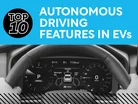
Top 10: Autonomous Driving Features in EVs
As EVs evolve, so do the advanced technologies driving them.
Autonomous features once considered futuristic are now essential, enhancing safety, reducing driver fatigue and laying the groundwork for full self-driving capabilities.
From adaptive cruise control to blind spot monitoring, these systems use sensors, cameras, radar and artificial intelligence to transform everyday driving into a smarter, safer experience.
Many of these innovations are now mandated or widely standardised, influencing both consumer expectations and automotive design worldwide.
In this week’s rundown, EV Magazine spotlights the top 10 most significant features advancing autonomy in the modern EV landscape.
10. Driver Monitoring System (DMS)
Top three companies: Mercedes-Benz, General Motors and Ford
First car involved: Toyota Lexus
First used: 2006
CEO of Toyota: Koji Sato
DMS is vital in EV autonomy, tackling human error – the cause of over 90% of crashes – by detecting distraction, drowsiness and inattention.
Now a regulatory requirement for Level 2/3 vehicles, DMS enables safer handover between driver and system.
Leading adopters include Tesla, GM, Ford, Mercedes-Benz, BMW, Kia, Smart Eye, Seeing Machines, Mobileye and FEV.
Their systems blend AI, cameras and real-time alerts, boosting both road safety and user experience across personal and commercial EV fleets.
9: Traffic Sign Recognition (TSR)
Top three companies: Volkswagen, Mercedes-Benz and Ford
First car involved: Vauxhall 2009 Insignia
First used: 2008
CEO of Vauxhall: Florian Huettl
TSR is a critical feature, enabling vehicles to interpret speed limits, warnings and stop signs for legal and safe navigation.
It underpins advanced driver assistance and autonomy by enabling real-time decisions in changing conditions.
As regulations tighten, TSR is essential for compliance and safety.
Companies using TSR include Tesla, BMW, Mercedes-Benz, Ford, Volvo, Volkswagen, Audi, Hyundai and Toyota. Leading AV developers like Waymo, Cruise and Mobileye are all enhancing EV intelligence and autonomy.
8. Remote Parking / Summon
Top three companies: Tesla, Hyundai and JLR
First car: Tesla
First used: 2019
CEO of Tesla: Elon Musk

Remote parking and summon features are a top EV innovation, offering hands-free convenience in tight spots.
Using smartphones or smart keys, drivers can park or retrieve vehicles remotely, ideal for safety, accessibility and precision.
These features support full control over steering, gear, and braking, advancing autonomous capability.
Hyundai, Kia, Tesla and JLR lead this space, with systems like RSPA, Smart Summon and Remote Control enhancing driver experience and showcasing the future of intelligent EV mobility.
7. Intersection Assist
Top three companies: Nissan, Renault and Hyundai
First car: Toyota Crown Majesta
First used: 2009
CEO of Toyota: Koji Sato

Intersection assist is a top feature, reducing crashes at high-risk junctions by using LiDAR, radar and cameras to detect cross traffic, cyclists or pedestrians.
It enables real-time emergency braking or steering, supporting safe and autonomous intersection navigation.
Nissan, Hyundai and Renault lead in adoption, integrating systems like ProPILOT, FCA-JT and Active Driver Assist.
These technologies mark a major step towards Level 3 autonomy by managing one of the road’s most complex and hazardous driving scenarios.
6. Automatic Parking Assistance (APA)
Top three companies: Hyundai, Volkswagen, Nissan
First car to use: Toyota Prius and Lexus (Japan)
First used: 2003
CEO of Toyota: Koji Sato
APA reduces stress, boosts safety and showcases practical autonomy.
Using sensors and cameras, APA handles steering, and often braking and throttle, to navigate tight spaces with ease.
Systems from Kia, Hyundai, Nissan, Volkswagen, Škoda and Smart automate parallel, perpendicular and even remote-controlled parking.
These features help drivers avoid scrapes, save time and gain confidence, while advancing real-world autonomous capabilities essential to the next phase of EV innovation.
5. Traffic Jam Assist (TJA)
Top three companies: Volkswagen, Ford and Honda
First car to use: Ford
First used: 2014-2015
CEO of Ford: Jim Farley
TJA eases stop-and-go congestion by controlling acceleration, braking and steering in low-speed traffic. It reduces fatigue, enhances safety and showcases SAE Level 2 autonomy already in action.
Leading adopters include MG Motor, Volkswagen, Honda, BMW, Ford and ORA.
These systems use adaptive cruise and lane-keeping to streamline city driving and cut stress.
For EV drivers, traffic jam assist is fast becoming a must-have for comfort and convenience.
4. Blind Spot Monitoring (BSM)
Top three companies: Volkswagen, Mercedes-Benz and Nissan
First car to use: Volvo
First used: 2003
CEO of Volvo: Martin Lundstedt

BSM is a key safety feature, detecting vehicles in blind spots to prevent collisions during lane changes or merges.
Using radar and cameras, it alerts drivers or intervenes automatically, essential for manual, assisted and autonomous driving.
BSM also enables safe AI-driven lane changes and integrates with wider ADAS functions.
Kia, MG, Hyundai, Volvo, Volkswagen, Nissan, Audi, Mercedes-Benz and Tesla all offer BSM, making it a standard in modern EVs focused on safety and autonomy.
3. Automatic Emergency Braking (AEB)
Top three companies: Volkswagen, Toyota and Mercedes-Benz
First car to use: Mid-2000s
First used: Volvo
CEO of Volvo: Martin Lundstedt
AEB is a top autonomous driving feature in EVs, using radar, cameras and LiDAR to detect imminent collisions and brake automatically, protecting occupants and other road users.
It cuts rear-end crashes by up to 50% and responds faster than human reflexes, especially in busy traffic.
Advanced systems also detect pedestrians and cyclists.
Now mandatory in the UK and EU and widely standard elsewhere, AEB is built into EVs from Tesla, Audi, BMW, Mercedes-Benz, Volvo, Volkswagen, Hyundai, Toyota, Nissan and more.
AEB forms the safety backbone of Level 2–4 autonomous systems and enhances real-world driving confidence across global markets.
2. Lane Keeping Assist (LKA) / Lane Centering
Top three companies: Volkswagen, Toyota and Mercedes-Benz
First car to use: Mercedes Actro Truck
First used: 2000
CEO of Mercedes-Benz: Ola Källenius

LKA / lane centering is essential to prevent accidental lane departures and enhance highway safety.
Using cameras and sensors, LKA gently steers the vehicle back into lane if it drifts, significantly reducing one of the most common accident types.
It also lowers fatigue by managing steering during long drives, keeping drivers more relaxed and alert.
As a foundation for SAE Level 2 autonomy, LKA works alongside adaptive cruise control and emergency braking to enable semi-autonomous driving. It responds faster than humans, particularly in situations involving distraction or drowsiness, and is now a core ADAS feature across the industry.
Leading EVs from Tesla, Mercedes-Benz, BMW, Hyundai, Kia, MG, Volkswagen, Renault, Toyota and Ford all offer LKA, often paired with systems like BlueCruise or Travel Assist.
Major suppliers like Bosch and Continental power the underlying tech, making LKA a vital enabler of safer, smarter and more comfortable electric mobility.
1. Adaptive Cruise Control (ACC)
Top three companies: Mercedes-Benz, Ford and Tesla
First car to use: Mitsubishi
First used: 1990s
CEO of Mitsubishi: Katsuya Nakanishi

ACC is a leading EV feature that automates speed and distance control using radar, cameras and in some cases, LiDAR.
Unlike traditional cruise control, ACC dynamically adjusts to traffic, maintaining safe following distances and easing driver workload in stop-and-go or high-speed conditions.
It significantly reduces rear-end collision risks and driver fatigue, especially on long motorway journeys.
Many advanced systems now read traffic signs to adjust speed automatically and optimise energy efficiency in EVs by smoothing acceleration and braking.
ACC forms a core part of SAE Level 1 and 2 autonomous systems, working seamlessly with lane keeping and emergency braking to enable partial hands-free driving.
ACC is offered by most major EV brands, including Kia (EV9), Hyundai (IONIQ 5), Tesla (Model Y), BMW (iX), Mercedes-Benz (EQS), Audi (e-tron GT), MG (MG4), Renault (Scenic E-Tech) and Ford (Mustang Mach-E).
It’s a cornerstone of autonomy and is fast becoming standard across the EV market.