The push to develop autonomous vehicle (AV) technology is changing the transport industry.
Major companies, traditional carmakers and startups are investing heavily to change how people and goods get around.
This shift isn’t just about automation — it’s about improving safety, scaling up operations and making vehicles more connected.
Progress ranges from Level 4 robotaxis to advanced driver assistance systems (Levels 2 and 3 ADAS).
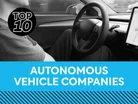
EV Magazine has ranked 10 of the top autonomous vehicle companies.

10. Volkswagen Group
- Founding Year: 1937
- Annual Revenue: US$351.3bn
- Group CEO: Oliver Blume - Board responsibility for CARIAD
- Employees: 646,500
Volkswagen Group is intensifying its focus on autonomous driving, committing significant resources to software development and electrification. Central to this strategy is the CARIAD division, which is building a unified software architecture and an autonomous driving stack designed to enable Level 4 automation.
The company’s upcoming Scalable Systems Platform (SSP) is set to underpin future electric models, allowing for swift software updates and enhanced flexibility. Volkswagen is also leveraging key partnerships, such as integrating Mobileye’s EyeQ™6 platform to deliver advanced Level 2+ driver assistance systems. These initiatives reinforce Volkswagen’s commitment to advancing autonomy across its global fleet.
9. BMW Group
- Founding Year: 1916
- Annual Revenue: US$154bn
- Member of the Board of Management of BMW AG, Purchasing and Supplier Network: Joachim Post
- Employees: 159,100
BMW Group is pushing forward with autonomous driving technology, emphasising advanced features for the premium segment. The company’s "Personal Pilot L3" system introduces SAE Level 3 automation, allowing drivers to delegate control at speeds up to 60 km/h on designated German motorways. Complementing this, the Level 2+ "Highway Assistant" offers hands-free driving at higher speeds and is available in several markets.
Both systems are underpinned by HERE Technologies’ AI-driven UniMap platform, enhancing real-time navigation and safety. Ongoing investment in research and development continues to shape BMW’s next-generation "Neue Klasse" architecture, positioning the brand for future mobility.
8. Intel (Mobileye)
- Founding Year: 1968
- Annual Revenue: US$53.1bn
- Chief Technology Officer: Greg Lavender
- Employees: 108,900

Intel’s autonomous vehicle strategy is driven by Mobileye, its majority-owned company specialising in advanced driver-assistance systems (ADAS) and autonomous driving technology. Mobileye’s EyeQ chips and camera-based systems are integrated into approximately 190 million vehicles worldwide, supporting a broad range of automakers.
Mobileye is advancing toward SAE Level 4 autonomy with the Mobileye Chauffeur platform, which incorporates full sensor redundancy — combining cameras, radar and lidar — and high-performance on-chip processing. Key technologies include REM™ crowdsourced mapping, which leverages data from vehicles globally to create high-definition maps, and the Responsibility-Sensitive Safety (RSS) policy, a rules-based framework designed to enhance safety in autonomous driving scenarios.
Mobileye collaborates with major automotive partners such as Volkswagen, Ford, Zeekr and NIO to integrate its technology into production vehicles and future robotaxi fleets. The company is actively testing its autonomous systems in diverse environments worldwide, with plans for broader consumer availability of self-driving technology by 2025.
7. Toyota Motor Corporation
- Founding Year: 1937
- Annual Revenue: US$305bn
- Executive President: Hiroki Nakajima
- Employees: 380,790
Toyota is progressing in autonomous vehicle technology with a comprehensive approach centred on safety. The Toyota Research Institute and Woven by Toyota, its dedicated software division, are at the forefront of these efforts. The company’s global Toyota Safety Sense (TSS) system underpins its advanced driver-assistance systems, while the “Teammate” platform brings higher levels of automation to select models.
A collaboration with Waymo highlights Toyota’s commitment to integrating advanced autonomous capabilities with its established vehicle platforms. Additionally, Woven City, Toyota’s purpose-built testing ground, plays a key role in developing and validating future mobility solutions.
6. General Motors (Super Cruise)
- Founding Year: 1908
- Annual Revenue: US$187bn
- Senior Vice President, Software and Services Engineering: Dave Richardson
- Employees: 162,000

General Motors has completed its acquisition of Cruise, making the autonomous vehicle company a wholly owned GM subsidiary. The move signals a shift in GM’s strategy, with Cruise’s technology and expertise now being integrated directly into GM’s Super Cruise system. Super Cruise, a Level 2+ hands-free driver assistance system, currently operates across 750,000 miles of mapped roads in North America and is available on more than 20 GM models.
Following the pause of Cruise’s robotaxi operations in late 2023, GM’s focus has moved away from commercial ride-hailing and toward enhancing advanced driver assistance systems for personal vehicles. The integration of Cruise’s autonomous vehicle capabilities is expected to accelerate the expansion of Super Cruise, including its rollout to surface streets and more complex urban environments.
GM reports that Super Cruise users log more than 10 million miles per month, and the company projects the system will become a significant revenue driver in the coming years. By combining Cruise’s autonomous technology with Super Cruise, GM aims to advance both assisted and fully autonomous driving for consumers, reinforcing its commitment to personal mobility and future innovation in the EV sector.
5. Amazon (Zoox)
- Founding Year: 1994
- Annual Revenue: US$574bn
- CTO/Tech Lead: Werner Vogels
- Employees: 1,556,000
Amazon entered the autonomous vehicle sector in 2020 with its US$1.2bn acquisition of Zoox, a startup focused on self-driving technology and urban mobility. Zoox is building a fully autonomous, bidirectional electric vehicle specifically designed for ride-hailing in dense city environments. The vehicle features a 360-degree sensor array and advanced safety systems, reflecting a ground-up approach rather than retrofitting existing cars.
Since the acquisition, Zoox has proceeded cautiously, operating employee-only robotaxi services in California and Nevada. The company remains a standalone business under Amazon, with its leadership and mission unchanged.
Backed by Amazon’s resources, Zoox is positioned to scale its operations and potentially integrate its autonomous technology into Amazon’s broader logistics and mobility services in the future
4. Mercedes-Benz Group
- Founding Year: 1926 (as Daimler-Benz)
- Annual Revenue: US$164bn
- Member of the Board, Development & Procurement & CTO: Markus Schäfer
- Employees: 175,260
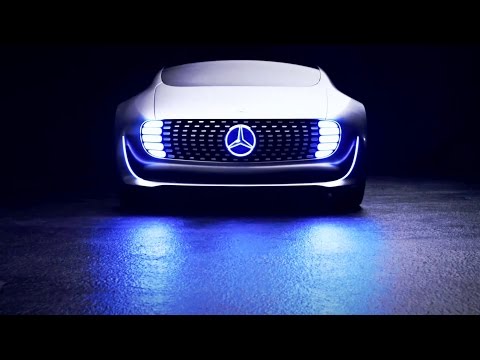
Mercedes-Benz has introduced DRIVE PILOT, its certified Level 3 automated driving system, now approved for use in Germany at speeds up to 95 km/h and in select US states, including California and Nevada.
DRIVE PILOT enables the vehicle to assume full control in specific freeway conditions, such as dense or slow-moving traffic, allowing the driver to engage in other activities while the system is active. This hands-off, eyes-off functionality is permitted only under defined circumstances — such as clear lane markings, a vehicle ahead and favourable weather during daylight hours.
The system relies on a comprehensive array of sensors, including LiDAR, radar, cameras, microphones and a road wetness sensor, to ensure safe and reliable operation. Redundant steering, braking and electrical systems are built in to maintain safety in case of component failure. DRIVE PILOT is available as an option on the S-Class and EQS models, with activation offered via subscription in the US market.
Mercedes-Benz continues to advance its ADAS (Advanced Driver Assistance Systems) capabilities through collaborations with technology leaders like NVIDIA and Google, aiming to further integrate next-generation autonomous features into its luxury vehicles. This positions the brand to deliver increasingly sophisticated, intelligent in-car experiences as part of its ongoing technology strategy
3. Tesla
- Founding Year: 2003
- Annual Revenue: US$94.7bn
- CEO: Elon Musk
- Employees (2024): 125,665

Tesla continues to lead in autonomous vehicle technology, leveraging its extensive global fleet and the data generated through its Full Self-Driving (FSD) Beta programme. The company’s approach is distinct, utilising a vision-based system that relies on cameras and artificial intelligence neural networks, all trained on billions of miles of real-world driving data.
Although FSD remains classified as SAE Level 2 and still requires active driver supervision, it is capable of handling both highway and urban environments. Tesla’s use of proprietary AI chips and large-scale data collection sets it apart from other manufacturers, even as regulatory discussions and scrutiny persist.
2. NVIDIA
- Founding Year: 1993
- Annual Revenue: US$60.9bn
- CTO/Tech Lead: Michael Kagan
- Employees: 29,600
NVIDIA plays a central role in autonomous vehicle development, delivering the AI computing infrastructure that underpins many leading platforms. Its DRIVE platform, featuring high-performance systems like Orin and the forthcoming Thor, supports a spectrum of automation, from advanced driver assistance to full self-driving capabilities.
The company’s technology stack is built around three core components: NVIDIA DGX for AI model training, Omniverse and Cosmos for simulation and synthetic data generation and DRIVE AGX for secure, real-time in-vehicle computing. This integrated approach enables developers to train, validate and deploy autonomous systems efficiently, using both real-world and simulated scenarios to accelerate progress.
NVIDIA’s ecosystem includes collaborations with major automakers such as Toyota, Mercedes-Benz, GM and Hyundai, as well as autonomous vehicle developers like Aurora, Zoox and Uber. These partnerships leverage NVIDIA’s hardware and software to bring advanced driver assistance and autonomous features to a wide range of vehicles.
Simulation tools like Omniverse and Cosmos are used to create diverse, physically accurate environments, allowing billions of driving scenarios to be tested virtually. This synthetic data is critical for training robust AI models and reducing reliance on real-world data collection. The DRIVE AGX platform, powered by safety-certified DriveOS, processes sensor data in real time to support safe decision-making on the road.
Through its unified platform and broad industry partnerships, NVIDIA is accelerating the deployment of intelligent, software-defined vehicles across the automotive sector.
1. Alphabet (Waymo)
- Founding Year: 2016
- Annual Revenue: US$307bn
- CEO, Alphabet & Google: Sundar Pichai
- Employees: 183,320

Waymo, Alphabet’s autonomous vehicle division, operates one of the largest commercial robotaxi fleets in the United States. The company’s Waymo One service runs fully driverless vehicles in cities including Phoenix, San Francisco, Los Angeles and Austin, completing more than 250,000 paid rides each week. Waymo’s fleet consists of more than 1,500 vehicles, with plans to add more than 2,000 additional autonomous Jaguar I-PACE units and expand to further cities such as Atlanta and Miami.
Waymo’s core technology, the Waymo Driver, integrates a suite of advanced sensors and artificial intelligence to navigate complex urban environments. The company’s Mesa, Arizona facility enables large-scale manufacturing and rapid integration of its sixth-generation Driver on new vehicle platforms, supporting tens of thousands of autonomous vehicles annually.
Backed by Alphabet’s resources and strategic partnerships, Waymo continues to refine its technology through extensive real-world and simulated testing. The company is also actively testing in new markets, sending vehicles to cities like Las Vegas and San Diego to gather data and adapt to varied driving conditions.
Waymo remains a benchmark for urban autonomous mobility, focusing on safety, scalability and operational efficiency.
Explore the latest edition of Sustainability Magazine and be part of the conversation at our global conference series, Sustainability LIVE.
Discover all our upcoming events and secure your tickets today.
Sustainability Magazine is a BizClik brand