
AI Breaks Barriers: Maserati MC20 Sets Autonomous Record
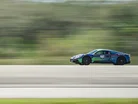
Spectators at the Kennedy Space Centre’s 2.8-mile runway recently witnessed a groundbreaking moment in automotive history.
A modified Maserati MC20 Coupe, nearly reaching 200 mph, sped down the track—but without a human driver behind the wheel. Instead, the high-speed test run was controlled by an advanced AI system, developed by engineers from Politecnico Milano, Italy’s largest scientific and technological university.
The test was part of the Indy Autonomous Challenge (IAC), a pioneering initiative aimed at advancing autonomous vehicle technology through high-speed racing.
During the event, the AI-driven Maserati set a new autonomous speed record of 197.7 mph (318 km/h), surpassing previous benchmarks and demonstrating the immense potential of AI in mobility.

AI-powered speed record
The record-breaking feat was made possible through a collaboration between IAC, Politecnico Milano, Maserati and the 1000 Miglia Experience Florida.
The test took place at the Space Florida Launch and Landing Facility, a site renowned for innovation, research and high-performance vehicle testing. With one of the world’s longest runways, the location provided the ideal setting for pushing the limits of AI-driven speed.
The AI driver software was developed by PoliMOVE-MSU, a division of AIDA (Artificial Intelligence Driving Autonomous) at Politecnico di Milano. The university specialises in research on autonomous systems, AI and mobility solutions, focusing on creating robust self-driving models that can operate safely on public roads.
For the challenge, AIDA’s performance division installed its AI software into a specially modified Maserati MC20 Coupe, allowing it to autonomously reach speeds never before recorded for a streetcar.
The achievement shattered the previous autonomous speed record of 192.8 mph (310.2 km/h), set by an IAC AV-321 racecar in 2022.
Paul Mitchell, CEO of IAC, stated: “These world speed records are much more than just a showcase of future technology; we are pushing AI-driver software and robotics hardware to the absolute edge.
“Doing so with a streetcar is helping transition the learnings of autonomous racing to enable safe, secure, sustainable, high-speed autonomous mobility on highways.”
Racing for real-world applications
Beyond setting records, the success of the AI-driven vehicle has far-reaching implications for the future of autonomous mobility.
The team at Politecnico Milano meticulously studied the behaviour of the vehicle under extreme conditions, enabling them to refine and enhance the reliability of autonomous driving algorithms.
Professor Sergio Matteo Savaresi, Scientific Director of the project and Director of the Department of Electronics, Information, and Bioengineering at Politecnico di Milano, explained: “These AI systems have been tested in production vehicles at legal road speeds in the Indy Autonomous Challenge races since 2021. The AIDA team used this test to push the boundaries of autonomous driving, improving safety and reliability.
“Conducted in controlled environments without a human driver, the test assesses the AI's stability, robustness and reaction time, ultimately enhancing safety for low-speed urban mobility situations.”
Bridging the gap between racing and road vehicles
Following the record-breaking test, a Maserati MC20 Cielo convertible from Politecnico di Milano participated in the 1000 Miglia Experience Florida, a prestigious event rooted in the historic 1000 Miglia race format.
It highlights the intersection between high-performance racing and real-world vehicle applications.
“The synergy between the 1000 Miglia Experience Florida and the groundbreaking autonomous driving technologies developed by the Politecnico di Milano represents an extraordinary step forward in the future of mobility."
The future of autonomous mobility
The success of the AI-driven Maserati MC20 marks a turning point in the evolution of self-driving technology.
By pushing the limits of speed, stability and AI decision-making, researchers and engineers are accelerating advancements that could one day lead to fully-autonomous, high-speed travel on public roads.
From racetracks to highways, the integration of AI in automotive performance is poised to redefine the way vehicles interact with infrastructure, paving the way for safer, more efficient, and highly responsive autonomous mobility solutions.
Lessons learned from high-speed testing will ultimately inform the development of AI-driven safety enhancements for everyday road users, bringing the future of mobility one step closer to reality.
Stay informed and inspired with the EV Magazine community by signing up for our free weekly newsletter. Each week, receive in your inbox the latest industry news and in-depth insights into the world of electric vehicles, sustainability and cutting-edge innovations
Subscribe now, don’t miss the opportunity to stay ahead in the fast-evolving EV industry.
EV Magazine is a BizClik brand.