E1 Series: Behind the Electric Boats Powering Team Brady
When Carlos Duarte, Chief Scientist at E1 and Distinguished Professor of marine science at King Abdullah University of Science and Technology, was first approached about helping to build a new powerboat series, his instinct was to say no.
"I never thought that I would be working on sports, particularly motor sports, because I do not really enjoy much noise and fumes and actually burning fuel for fun," Carlos says.
Electric propulsion changed the equation for him. "Electric motor sports have a different value proposition," he says, because they allow boats to operate "without introducing chemical pollution and noise that comes from combustion engines".
While electric vehicles have already become a familiar part of the energy transition on land, the marine sector tells a different story. Carlos points out that electric mobility on water is "lagging behind 15 years" and still routinely cedes rivers, lakes and coasts to internal combustion.
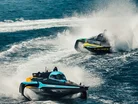
By putting fully electric foiling powerboats in front of a global television audience, E1 is trying to compress those 15 years of delay into just a few seasons.
For Ben King, Co-Team Principal of Team Brady, the lure of E1 was always about more than silverware. "E1 is an incredible platform for promoting sustainable technologies, for helping to restore the health of our oceans," he says.
Performance through energy efficiency
Joe Sturdy, the other half of Team Brady's leadership duo, has a background in Formula 1 engineering and sees E1 as a kind of laboratory.
"We are a team of engineers, most people in the team have got some kind of engineering background. We have a no-stone-unturned approach when it comes to performance," he explains.
On the water, that means endlessly refining how the electric powerboats fly on their foils, managing power delivery and battery usage to extract maximum speed from a finite energy budget.
The engineering challenge mirrors what EV manufacturers face on land: optimising every kilowatt-hour to maximise range and performance.
"It's been great to translate that approach across to the sustainability work because we can have the same approach," Joe says. "We look for marginal gains in all areas, just small improvements, building on what has been done before."
Racing towards sustainable impact
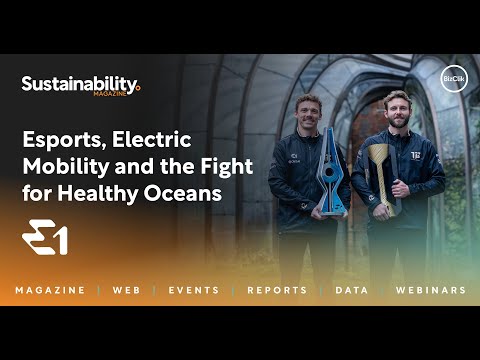
The Blue Impact Championship, introduced in 2024 after E1's first season, gave structure to that ambition.
The idea came about after E1's organising body decided to bring an element of competition to the sustainability endeavours of each of the teams, with a trophy presented to the league's most sustainable team at the end of every season.
Carlos describes E1 as "a sport with a purpose", where the aim is "not just to entertain and advance the technology of electric mobility, but also to deliver the highest possible positive impact on aquatic ecosystems".
Teams are judged by an independent jury on the rigour and scale of their projects, from cutting emissions and noise to tackling plastic waste and improving water quality.
Carlos argues that this competitive framing matters for energy and technology as much as conservation.
"Sports is about breaking the limits of the possible," he says, and competition, to deliver impact pushes the boundaries of the type of impact that we can deliver."
Team Brady won the inaugural title in 2024.
Accelerating marine electrification
Carlos believes that experiments like E1's can influence far more than a single sport.
Electric powerboats can "advance technology, in this case, electric mobility on water" and demonstrate new pathways for people and industries to "contribute to solving problems in the ocean".
The technology developed in E1 could show how electric propulsion systems perform under extreme conditions, providing valuable data for commercial marine applications.
Crucially, Carlos thinks the days of waiting for policy alone to drive the transition are over.
"It has become crystal clear that the solution is not going to come from policy makers and governments. It has to come broadly from society," he says, with the private sector and sport acting as "great mobilisers".
E1's ability to communicate sustainability messages to large audiences is multiplied by the A-listers involved in running the teams.
With icons like Tom Brady, Rafael Nadal and Steve Aoki in charge of the crews, E1 hopes its message will reach far more people.
"If everybody just looks at the marginal gains and looks at just taking small steps in the right direction together, everyone can benefit from it," Joe explains.
Company portals


Executives
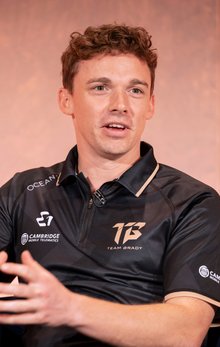
Ben King
Co-Team Principal
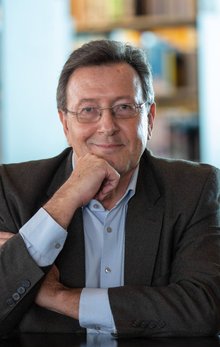
Carlos Duarte
Chief Scientist
Joe Sturdy
Co-Team Principal