
How will Trump’s Tariffs Impact EV Trade Tensions?
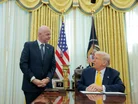
US President Donald Trump’s latest tariff round is now in place, adding new cost pressures to EV supply chains and drawing criticism from key trade partners including Switzerland.
Tariffs are hitting sectors essential to EV manufacturing, including semiconductors, precision machinery and specialist industrial goods.
These are core inputs in battery systems, onboard electronics and assembly equipment and they are now subject to higher import duties.
At midnight on 8 August, President Trump’s deadline passed and new measures aimed at what the White House calls "reciprocal" trade adjustments took effect.
Writing on Truth Social, Trump said: "IT’S MIDNIGHT!!! BILLIONS OF DOLLARS IN TARIFFS ARE NOW FLOWING INTO THE UNITED STATES OF AMERICA!"
The measures include a 25% tariff on India, targeting oil trade with Russia, and the President says more increases on Chinese goods are next.
During a meeting with Apple CEO Tim Cook, Trump stated the US is considering a 100% tariff on "all chips and semiconductors coming into the United States".
He also set out plans for tariffs of up to 250% on pharmaceutical imports.

Swiss backlash to US import charges
Washington’s move to impose a 39% tariff on Swiss exports has drawn strong reaction in Bern.
Announced on 1 August, the tax is based on a trade deficit calculation that Swiss officials say is outdated.
For Switzerland’s industries, the tariff strikes at products with no US-made equivalents.
Luxury watches and chocolate grab headlines, but more critical to EV supply chains are precision industrial components, including parts for US aerospace firms such as Boeing and high-specification tools used in EV assembly.
President Karin Keller-Sutter and Economics Minister Guy Parmelin travelled to Washington to challenge the measure but did not meet Trump.
Instead, they held talks with US Foreign Minister Marco Rubio.
Following the meeting, Karin wrote: “At today’s meeting with Foreign Minister [Marco Rubio] we discussed bilateral co-operation between Switzerland and the US, the customs situation and international issues.”
Swiss political voices are suggesting unconventional routes.
National Councillor Roland Rino Büchel of the Swiss People’s Party said: “It is definitely time to bring in Gianni Infantino now without further delay to help open doors.”
Trump has called the FIFA President “a friend of mine” and appeared with him several times this summer.
Despite the impact, Switzerland says it will not impose its own retaliatory tariffs.
Instead, officials are working on measures to support affected companies, including EV sector suppliers.
Semiconductor tariffs hit EV manufacturing
The latest tariffs reach deep into EV production lines. Semiconductor imports face potential 100% duties, a cost hike that could disrupt sourcing strategies for battery management systems, onboard controllers and vehicle sensors.
Pharmaceutical tariffs, while outside direct EV manufacturing, affect the wider industrial base and logistics chains, especially as some specialist chemicals used in battery manufacturing are classed under pharmaceutical categories.
Mexico, the US’s largest trading partner, has been given a 90-day reprieve.
Canada faces a 35% tariff on some goods, but products covered by the US-Mexico-Canada Agreement are exempt.
A deal with South Korea adds a 15% tariff on imports while leaving US exports exempt.
Another structural change comes with the removal of the de minimis exemption, which currently allows goods under US$800 to enter tariff-free.
From 29 August, these too will be taxed, meaning small-scale shipments of EV parts and components will cost more to import.
These changes create new layers of cost calculation for EV supply chain managers.
European talks continue, uncertainty remains
The EU is still in negotiations with Washington.
Switzerland, meanwhile, has expanded its negotiating team to include more conservative and finance officials, in a bid to push back against the 39% rate.
For EV manufacturers and their suppliers, the uncertainty could add another factor to an already complex production environment marked by high commodity prices and competitive demand for specialist parts.