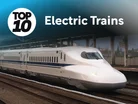
Top 10: Electric Trains
The first electric passenger train was presented by Werner von Siemens in 1879.
By 1881, the public in Germany were riding electric trains and in 2026, they are in use around the world.
The railway landscape is increasingly defined by electrification and modular standardisation over bespoke engineering.
This list of the world’s most prolific rail models shows a move from regional icons, such as Japan’s JNR 103 Series, to versatile, cross-border models like the Alstom Coradia and Siemens Vectron.
EV Magazine has ranked 10 of the top electric trains.
10. Siemens Mobility Vectron
First Manufactured: 2010
Fleet Size: 2,700+

The Vectron is Europe’s most successful modular locomotive platform. Launched in 2010 to succeed the EuroSprinter, it was designed for seamless cross-border freight and passenger services.
Primarily manufactured at Siemens’ Munich-Allach plant, over 1,000 units have been sold to more than 50 operators in 16 countries. Known for its high reliability and multiple power configurations, a single unit typically costs up to US$6.2m, depending on the specific country-specific safety systems required.
9. Stadler Rail FLIRT
First manufactured: 2004
Fleet size: 2,750+
FLIRT is an acronym for ‘Fast Light Intercity and Regional Train’. It has become a staple of European regional travel since 2004.
These articulated multiple units are manufactured in Switzerland, Poland and Belarus, with more than 2,500 units made globally, operating from the Arctic Circle in Norway to the heat of Algeria.
They are praised for their lightweight aluminium frames and rapid acceleration. A standard four-car set generally requires an investment of approximately US$10-13m.
8. Bombardier Electrostar
First manufactured: 1999
Fleet size: 2,800
The Electrostar is the most common electric multiple unit (EMU) on the British railway network.
Manufactured at the historic Derby Litchurch Lane Works between 1999 and 2017, the family includes the Classes 357, 375, 377, 378, 379 and 387.
More than 2,800 vehicles were produced, primarily serving London and the South East. While production has ended following Bombardier's acquisition by Alstom, they remain the backbone of the UK commuter experience.
7. JNR Group 113 Series
First manufactured: 1963
Fleet size: 3,000
Introduced by Japanese National Railways (JNR) in 1963, the 113 Series was the definitive suburban train for Japan’s post-war urban expansion.
Operating across the Tōkaidō and San'yō Main Lines, 3,000 cars were produced to handle the massive surge in commuter demand.
These steel-bodied units were designed for versatility, featuring high-capacity seating and durability. Although largely replaced by stainless steel successors, they laid the operational blueprint for the high-density suburban networks that define Japanese rail today.
6. Alstom Traxx
First manufactured: 2000
Fleet size: 3,000+
The Traxx platform, originally developed by Adtranz and Bombardier, is the primary rival to the Siemens Vectron.
It is a modular locomotive capable of pulling heavy freight or 200 km/h passenger trains. Manufactured largely in Kassel, Germany, and Vado Ligure, Italy, the platform is renowned for its energy efficiency and "Last Mile" diesel engines that allow electric locomotives to navigate non-electrified sidings.
Average manufacturing costs hover around US$5.5m.
5. Hitachi 0 Series Shinkansen
First manufactured: 1963
Fleet size: 3,200
The 0 Series is the "Bullet Train" that changed the world. Launched in 1964 for the Tokyo Olympics, it was the first high-speed rail set in history.
Built by a consortium including Hitachi and Kawasaki, 3,213 cars were produced between 1963 and 1986. They operated exclusively on the Tōkaidō and San'yō Shinkansen lines, originally reaching speeds of 210 km/h.
While they were retired in 2008, their legacy lives on in every high-speed rail project globally, from Europe to China.
4. J-TREC, Kawasaki E233 Series
First manufactured: 2006
Fleet size: 3,400
The E233 Series is the modern face of the Greater Tokyo Area’s rail network.
Since 2006, more than 3,400 cars have been manufactured by J-TREC and Kawasaki Heavy Industries. These stainless steel EMUs are the most common train type currently operated by JR East, serving critical arteries like the Chūō and Yamanote lines.
Known for having redundant electrical systems to prevent delays, they are a high-efficiency solution for the world's busiest commuter lines.
3. JNR Group 103 Series
First manufactured: 1963
Fleet size: 3,500
The 103 Series is the most prolific commuter train in Japanese history, with 3,503 cars produced between 1963 and 1984. Designed by Japanese National Railways for high-density urban transit, these units were the workhorses of the Tokyo and Osaka loop lines for four decades.
They were engineered for high-frequency stopping and starting, prioritising standing room and rapid passenger turnover over long-distance comfort.
Operating primarily on 1,500V DC networks, the 103 Series was known for its vibrant, line-specific liveries ranging from Vermilion Orange to Sky Blue.
While production costs were kept low through standardised steel construction, their durability was legendary. Today, they have reached "endangered" status, with only a handful of units remaining in service with JR West and JR Kyushu, having been largely replaced by the more energy-efficient E231 and E233 series.
2. Alstom Coradia
First manufactured: 1999
Fleet size: 4.500
The Alstom Coradia is a massive family of regional trains that has seen more than 4,500 units sold across 15 countries.
Spanning three decades of development, the family includes the popular Coradia Lint (diesel), Coradia Continental and the high-speed Coradia Stream.
These trains are the primary choice for European regional operators, with significant fleets in Germany, France, Italy and the Nordic countries. They are manufactured across Alstom’s European sites, notably in Salzgitter, Germany, and Savigliano, Italy.
The Coradia family is at the forefront of the energy transition; the Coradia iLint was the world's first passenger train powered by a hydrogen fuel cell.
Their modular design allows operators to choose between single or double-deck versions, catering to everything from rural branch lines to high-capacity intercity corridors between major European capitals.
1. CLW WAG-9
First manufactured (by ABB): 1995
Fleet size: 7,000
The WAG-9 (Wide, AC, Goods, 9th generation) is the undisputed heavyweight of the Indian railways.
Originally developed by ABB in 1995, it is now manufactured primarily by Chittaranjan Locomotive Works (CLW). As of early 2026, more than 6,900 units have been produced, making it the most prevalent high-power electric locomotive in the world.
It operates across the entire electrified Indian broad-gauge network, hauling the country's essential coal, steel and container traffic.
A single WAG-9 produces more than 6,000 horsepower and is designed to handle the extreme climatic conditions of the Indian subcontinent. The "H" (Heavy) and "i" (IGBT) variants have further refined its efficiency.
Due to massive economies of scale and indigenous manufacturing, a WAG-9 costs approximately US$1.7m to produce, a fraction of the price of its European counterparts. It is the engine of the Indian economy, facilitating the movement of millions of tonnes of freight daily.