Top 10: Electric Buses
Electric buses are redefining public transport as cities push for cleaner, quieter and more efficient mobility.
Manufacturers are now delivering models with greater range, faster charging and smarter energy management, making zero-emission operations viable across both urban and regional networks.
Advances in battery chemistry, lightweight construction and modular drivetrains are improving performance while reducing total cost of ownership for operators.
Passenger comfort, safety and accessibility are also continuing to rise as standard expectations.
In this list, EV Magazine ranks the top electric buses based on speed, showcasing vehicles that combine reliability, innovation and real-world capability to keep modern transport systems moving.
10. Xcelsior CHARGE
Company: New Flyer
CEO: Paul Soubry
Top speed: 40mph
New Flyer’s Xcelsior Charge NG earns its place by combining next generation efficiency, strong performance and smart city readiness.
Available in 35, 40 and 60 foot models, it uses high energy NMC batteries, a lightweight Siemens ELFA 3 traction system and streamlined protective battery enclosures to extend range by up to 13% while improving serviceability.
The Xcelsior can now recover 90% of energy, enhancing daily efficiency and flexible charging options including rapid on-route charging, all of which support 24-hour operation.
Passenger capacity reaches 88, with advanced accessibility features such as the SmartRider ramp.
9. Mercedes‑Benz eCitaro
Company: Mercedes-Benz
CEO: Ola Källenius
Top speed: ~43mph
The Mercedes-Benz eCitaro sets a benchmark for electric city buses by combining proven Citaro design with advanced NMC4 batteries, efficient thermal management and a comprehensive e-mobility ecosystem.
It delivers up to 400 km on a single charge, or up to 600 km with maximum battery configuration, while accommodating up to 88 passengers on the rigid model and 146 on the articulated version.
The bus's safety systems, including its advanced driver assistance and robust structural protection, help to boost confidence in dense urban traffic.
With strong efficiency, high passenger comfort and integrated fleet data capabilities, the eCitaro supports reliable zero-emission transport for modern cities.
8. Ebusco 3.0
Company: Ebusco
Founder: Peter Bijvelds
Top speed: ~50mph

Ebusco 3.0 is regarded as a game-changing electric bus, built around an ultra lightweight composite body to cut weight by up to 5,000kg and deliver the lowest total cost of ownership in its class.
With energy efficient design, insulated walls and integrated batteries in a fully flat floor, it offers a quiet, comfortable ride and optimal climate control for up to 110 passengers on the 12m model and 150 on the 18m.
A range of up to 700km on a single charge supports full-day operations, while non-flammable LFP batteries and real-time monitoring enhance safety and reliability for operators.
7. MAN Lion’s City E
Company: MAN Truck & Bus
CEO: Alexander Vlaskamp
Top speed: 50mph
The MAN Lion’s City E range offers up to 380 kilometres on a single charge, extended further through regenerative braking.
Available in 10.5, 12 and 18 metre models, it balances capacity with excellent manoeuvrability for demanding urban routes.
Modular lithium-ion batteries provide 356 to 712 kWh depending on configuration, with full charging in two and a half to five hours.
Roof-mounted batteries maximise interior space, while advanced safety systems and digital fleet tools support efficient, reliable and sustainable electric bus operations.
6. Wrightbus StreetDeck Electroliner
Company: Wrightbus
CEO: Axel J. Maschka
Top speed: ~50mph
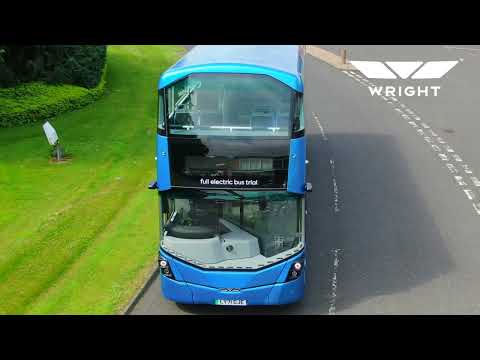
The StreetDeck Electroliner Gen 2.0 is a next-generation battery electric double deck bus designed to cut emissions and operating costs while maintaining full passenger capacity.
Its 442 kWh liquid-cooled LFP battery delivers up to 275 miles of range, with best in class rapid charging in around 1.25 hours via CCS or opportunity charging.
Commonality with the GB Kite Electroliner simplifies parts, training and depot operations, while capacity for up to 84 passengers ensures efficient, comfortable zero-emission travel in busy UK cities.
5. VDL Citea Electric
Company : VDL
CEO: Rolf-Jan Zweep
Top speed: ~50mph
VDL’s new generation Citea secures its place among the top 10 electric buses by rethinking zero emission transport from the ground up.
Designed entirely around an electric driveline, it integrates floor-mounted batteries, a lightweight one-piece composite side wall and advanced energy management to maximise efficiency and range.
With up to 600 km of real-world capability and space for as many as 110 passengers in a 12.2 metre model, it offers outstanding capacity, comfort and year-round performance.
Its modular platform simplifies maintenance and fleet integration, delivering a futureproof solution for modern urban mobility.
4. Yutong E-series (E10)
Company: Yutong
CEO: Jack Zhu (Yutong Western Europe)
Top speed: ~50mph
Yutong’s E10 earns its position as a top 10 electric bus through proven reliability, strong safety credentials and efficient zero-emission performance.
With more than 40 billion km of operational experience behind its technology, the 10.9 metre single deck model carries up to 70 passengers and delivers a smooth, quiet ride supported by full air conditioning and a 215 kW PMSM motor.
Its 422.87 kWh liquid-cooled LFP battery, protected by Yutong’s YESS safety system, enables dependable daily operation, while CCS2 fast charging and low maintenance demands make it a cost-effective choice for modern fleets.
3. Solaris Urbino Electric
Company: Solaris
CEO: Agata Stańda
Top speed: ~53mph

The Solaris Urbino 10.5 electric firmly earns its place among our top 10 electric buses thanks to its compact design, high capacity and market-leading range.
At 10.5 metres it carries up to 85 passengers and manoeuvres easily even on narrow city streets.
Its 400 kWh-plus battery system delivers more than 600 km per charge in official tests, enabling full-day operation without recharging.
The modular drive architecture shares components across the Urbino family, reducing maintenance complexity and improving reliability.
Its capacity, agility, endurance and operational efficiency all come together to make the Urbino 10.5 electric a standout in electric bus fleets.
2. Volvo 7900 electric
Company: Volvo
CEO: Håkan Samuelsson
Top speed: 59mph

The Volvo 7900 Electric range delivers clean, quiet and efficient public transport tailored to busy urban routes.
Available in 12, 18 and 18.7 metre configurations, the buses can carry up to 150 passengers while maintaining a compact 2.5 metre width and 3.3 metre height.
Powerful electric drivetrains, with up to 2x200 kW motors and 31,000 Nm wheel torque, are paired with an efficient 2-speed automated transmission for smooth acceleration and reliable performance.
Flexible charging options include OppCharge fast charging up to 450 kW and CCS up to 250 kW, supported by lithium-ion traction batteries with capacities up to 565 kWh and automatic thermal management.
Passenger comfort is ensured by high-capacity climate systems and low interior noise.
A comprehensive suite of active safety technologies, from collision warning and lane support to tyre pressure monitoring and AVAS, helps protect passengers, drivers and vulnerable road users as cities move towards zero-emission mobility.
1. BYD K9
Company: BYD
CEO: Wang Chuanfu
Top speed: 62.5mph

BYD’s 12m battery-electric bus sets a new benchmark for long-range zero-emission transport, combining safety, efficiency and comfort in a single platform.
Powered by BYD’s proprietary iron phosphate battery, the bus delivers a smooth and quiet ride with no tailpipe emissions and a market-leading range of more than 250km per charge.
Its Intelligent Battery Management System ensures balanced charging and robust protection, supporting a battery life that exceeds 4,000 cycles without the need for replacement under normal operation.
With energy consumption of just 1.3kWh per km, operators benefit from lower running costs, saving approximately US$0.18 per km while avoiding maintenance expenses typical of diesel, CNG or hybrid fleets.
The focus on passenger comfort, reduced noise and dependable performance makes the bus an attractive option for operators advancing their sustainability commitments and improving the passenger experience on busy urban routes.