
Why is GM Idling 1,300 Workers at its Flagship EV Plant?
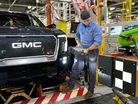
General Motors (GM) is temporarily halting production at its Detroit-Hamtramck assembly plant called Factory ZERO, where it manufactures EVs.
Kevin Kelly, Senior Director of Corporate News Relations at GM, told Crain’s Detroit Business: “Factory ZERO will temporarily adjust production to align EV production with market demand.”
The news comes as GM recorded a US$6bn charge to close some EV related investments in January 2026.

Production halting at GM’s Factory ZERO
“Impacted employees will be placed on a temporary layoff and may be eligible for subpay and benefits in accordance with the GM-UAW national contract," Kevin told Crain’s Detroit Business in an email.
According to Crain’s Detroit Business, the 1,300 workers remaining at Factory ZERO will be temporarily idled for the period March 16th 2026 to April 13th 2026.
This latest news follows a mass layoff at the plant in 2025, where GM announced via a WARN Act notice to the State of Michigan that GM planned to layoff 1,140 workers at the plant.
GM listed its reason for the company action in 2025 as “due to production schedule adjustment required to adapt to slower near-term EV adoption”. The workers who lost their jobs in the move included Quality Operators, Assembly Operators, and Material Operators.
About Factory ZERO
In 2020, GM announced a US$2.2bn investment in its Detroit-Hamtramck assembly plant, which was designed to produce a variety of all-electric trucks and SUVs as Factory ZERO.
The EVs manufactured at the plant include the GMC HUMMER EV Pickup, 2024 GMC HUMMER EV SUV, Cadillac LYRIQ and the Cruise Origin.
The plant has been open since 1985. Before the plant production lines shifted to EVs, the plant produced and built the Cadillac CT6 and the Chevrolet Impala.
At the opening of the plant, which was attended by former US President Joe Biden, GM Chair and CEO Mary Barra, said: “GM’s manufacturing expertise is key to achieving our all-electric future.
“This is a monumental day for the entire GM team. We retooled Factory ZERO with the best, most advanced technology in the world to build the highest quality electric vehicles for our customers.”
GM's ICE plant in Flint
GM's Flint Assembly plant in Michigan that makes ICE vehicles is going to run six days a week from June 2026, according to the Wall Street Journal. The reasoning GM cited for this was strong demand for powerful pickups, even with high fuel prices.
GM’s plant in Flint is its longest running assembly site in North America, where it has been producing cars since 1947.
The factory is now known for manufacturing heavy duty trucks such as the Chevrolet Silverado 2500. In GM’s financial year 2025, it recorded its best total Silverado sales in 5 years.
According to the Wall Street Journal, a GM spokesperson said: “General Motors is making strategic adjustments to Flint Assembly’s production schedule to align with strong customer demand.”
In 2026, GM's Flint Assembly plant built its 16 millionth vehicle.
EV leaders won’t want to miss Sustainability LIVE: The US Summit, taking place at Navy Pier, Chicago, on April 21–22.
Co-located with Procurement & Supply Chain LIVE, the event unites senior decision-makers at a time when supply chains, sustainability and business performance are more interdependent than ever.
Secure your place now for The US Summit – group booking discounts available.
Pivoting away from EVs
GM recorded a US$6bn charge to close some EV investments in January 2026. In its assumptions for 2026, announced with its 2025 Earnings, GM expected EV losses to improve by US$1bn to US$1.5bn from “right-sizing EV capacity” and significantly lowering volume.
Carmakers across the board have recorded write-downs of billions for EV related production with brands including Ford, Stallantis and Porsche.
Under US President Donald Trump, major changes have been made to the EV landscape in the US. President Trump vowed to “eliminate the electric vehicle mandate” in his Executive Order titled “Unleashing American Energy”.
The New Clean Vehicle Credit, Previously-Owned Clean Vehicle Credit and Qualified Commercial Clean Vehicle Credit measures all expired in September 2025, which offered US EV buyers an incentive to switch to electric vehicles.
EV makers in the US also face steep competition from Chinese brands, tariffs and global geopolitical turmoil, which can negatively influence supply chains.
Company portals

Executives

Kevin Kelly
Senior Director, Corporate News Relations

Mary Barra
CEO