What's Inside Tesla's Texas Lithium Refinery?
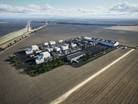
Tesla's lithium refinery in Corpus Christi, Texas has reached full operational capacity, aiming to produce enough material to make a million EVs each year.
On social media platform X, the company stated that this achievement "marks the beginning of energy independence for North America."
The facility represents an investment of more than US$1bn and is the first industrial deployment of an acid-free lithium refining route.
This process eliminates hazardous reagents and its by-products, sand and limestone, can be reused in the production of construction materials.

Large-scale industrial engineering
Constructed across a site covering more than 480 hectares the refinery is a technological showcase.
In contrast to traditional refineries that rely on energy-intensive "acid roasting", a method using concentrated sulphuric acid, Tesla's operation uses a proprietary alkaline leach process.
This novel methodology is entirely acid-free, significantly diminishing reliance on dangerous reagents and removing the generation of harmful by-products including sodium sulphate.
The process instead yields a harmless, sand-like substance called Analcime.
Local economic growth
Beyond the technical parameters, the facility has been framed as a catalyst for regional economic advancement.
Since construction began in 2023, the project has created more than 1,000 temporary construction positions and currently maintains more than 250 permanent employees including specialist technicians, operations supervisors and chemical engineers.
Tesla's investment in the Coastal Bend area includes educational initiatives.
The organisation has built talent pathways through funding commitments to the Robstown Independent School District, together with apprenticeship schemes at Del Mar Community College and internship programmes with Texas A&M University–Corpus Christi.
Supply chain evolution
The refinery's principal product is battery-grade lithium hydroxide, an essential element for high-nickel cathode batteries.
Through processing spodumene concentrate, hard-rock ore, directly at the facility, Tesla has eliminated the extensive 32,000-kilometre transportation route that historically involved raw materials being shipped to Asia for processing before returning to manufacturing sites in the West.
With a planned capacity to facilitate production of roughly a million electric vehicles per year, scaling towards 50 GWh, the operation could represent a foundation of Tesla's objective to advance the worldwide shift to sustainable energy.
Following the facility's achievement of full operational status, Tesla revealed it would discontinue its established Model S and Model X programmes.
The manufacturing lines at the Fremont facility, which previously defined the premium electric sedan sector, are now being converted to produce the Optimus humanoid robot.
All EV leaders should attend:
- Sustainability LIVE: The Net Zero Summit, featuring EV LIVE - QEII Centre, London, 4-5 March 2026
- Sustainability LIVE: The US Summit - Navy Pier, Chicago, 21-22 April 2026
Co-located with Procurement & Supply Chain LIVE, these events bring together Chief Sustainability Officers, Chief Procurement Officers and senior decision-makers to discuss the strategies building the future.
Book your tickets online today with group discounts available