
Electric Ferry MF Ampere Marks 10 Years of Innovation
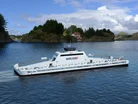
Since its launch in 2015, the MF Ampere has transformed the maritime industry, sailing an astonishing distance equivalent to 17 times around the equator entirely on battery power.
This milestone cements its legacy as a pioneering force in sustainable transport and a model for future innovations in green shipping.
Fjellstrand Shipyard: Leading the charge in electric vessels
The MF Ampere was designed and built by Fjellstrand Shipyard, a company with a rich history dating back to 1928.
Fjellstrand has positioned itself as a leader in battery-powered vessel technology, specialising in energy-efficient ship designs, vessel conversions, hybrid battery installations and general ship maintenance.
Overseeing the entire shipbuilding lifecycle—from engineering and design to construction—has been pivotal in advancing sustainable maritime transport.
At the heart of MF Ampere's success is Corvus Energy, a leading supplier of energy storage systems for maritime and offshore applications.
Corvus Energy provides modular lithium-ion battery solutions and hydrogen fuel cell systems, helping to power over 50% of the world's zero-emission vessels.
After completing more than 1,200 projects, Corvus Energy continues to shape the evolution of sustainable marine transport.
From concept to reality: A bold decision that changed the industry
Norway is a global leader in green shipping, largely due to the electrification of its ferry fleet.
The movement began with a bold decision by the Norwegian Public Roads Administration, which mandated using sustainable technology in designing a new ferry for the Lavik-Oppedal route across the Sognefjord.
Norled, the ferry operator, embraced the challenge and partnered with Fjellstrand Shipyard to create a cutting-edge electric vessel.
Edmund Tolo, R&D and Sales Manager at Fjellstrand, states: "When Fjellstrand Shipyard first started looking at electric ferries in 2010, we knew that a fully-electric ferry would be challenging on this route due to the distance and power demands.
"However, when the tender came out and Norled wanted to make this ferry all-electric, we revisited the idea and found solutions that we thought could work.
"By leveraging existing, proven vessel designs from previous projects and using our expertise in lightweight and optimised energy designs, we managed to create a vessel that is efficient and fully aligned with the future of sustainable transport."
Economic and environmental success
Since its deployment, the MF Ampere has delivered outstanding economic and environmental benefits. By switching to electric propulsion, the ferry has reduced CO2 emissions by 5,700 tons per year, substantially contributing to Norway's decarbonisation efforts.
Additionally, the ferry has achieved an 85% to 90% reduction in operational costs per crossing, resulting in total savings of nearly US$15m. The cost of operating the MF Ampere per crossing is now comparable to a waffle and a cup of coffee—a striking testament to the efficiency of electric ferry technology.
Heidi Wolden, CEO of Norled, adds: "Our experience with this vessel shows that it pays off to invest in electric ferry operations, both for the environment and society by creating new jobs in the maritime industry and because electric operation is cheaper than diesel in the long term.
"Ampere earlier accounted for 4% of our fleet with zero emissions, but we now have close to 50% of our fleet with low to zero emissions. Going forward, we will work on getting more vessels to low and zero emissions."
The ripple effect: electrification of global ferry fleets
The MF Ampere's success has inspired the widespread adoption of electric ferry technology worldwide. More than 80-90 ferries in Norway have since transitioned to electric propulsion and many other countries have followed suit.
Fredrik Witte, CEO of Corvus Energy, continues: "Since 2015, the Ampere has crossed the Sognefjord more than 124,000 times and proven that electric vessels are economical and sustainable.
"The demonstrated cost and emissions savings paved the way for the electrification of another 80-90 ferries in Norway. It has also accelerated the development of lighter and more energy-dense battery systems.
"To compare, the MF Ampere originally had 1 MWh of our first-generation batteries installed, while our largest system to date—powering the Incat ferry in South America—will have almost 42 MWh of our lightweight Dolphin batteries onboard. But without the MF Ampere as our pilot project, we wouldn't be where we are today in marine electrification."

The MF Ampere continues to evolve. With new batteries installed to extend its lifespan, it will remain in operation until the next wave of groundbreaking maritime innovation emerges. By 2026, four autonomous electric ferries aim to take over the route, representing another leap forward in sustainable transport.
As the maritime industry increasingly shifts towards zero-emission solutions, the MF Ampere stands as a symbol of innovation, sustainability and economic viability. Its legacy continues to ripple through the industry, shaping the future of green shipping for generations.
Stay informed and inspired with the EV Magazine community by signing up for our free weekly newsletter. Each week, receive in your inbox the latest industry news and in-depth insights into the world of electric vehicles, sustainability and cutting-edge innovations
Subscribe now, don’t miss the opportunity to stay ahead in the fast-evolving EV industry.
EV Magazine is a BizClik brand.