
Can DP World’s Fuel Switch Accelerate EV Truck Adoption?
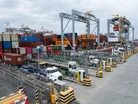
DP World introduced its Low Carbon Truck Programme (LCTP), offering an alternative fuel strategy at its London Gateway and Southampton terminals.
The programme, which runs for 28 months, gives heavy goods vehicle (HGV) operators access to Hydrotreated Vegetable Oil (HVO) at no additional cost, a step intended to reduce emissions and ease the shift towards electrification in road freight.
Every day, more than 4,000 trucks enter DP World’s UK ports, contributing substantial CO₂ emissions across the logistics chain.
With commercial EV trucks still in limited supply and infrastructure rollout underway, the LCTP provides an immediate alternative to fossil diesel.
DP World has committed to supporting at least 500 trucks through the programme during its trial phase.

Supporting low-emission logistics
HVO is a renewable fuel derived from vegetable fats and oils, refined through a hydrotreatment process.
Compared with diesel, it offers up to 85% lower carbon intensity.
Because HVO can be used in existing diesel engines without modification, it provides a ready-to-deploy transition fuel for operators waiting for commercial EV trucks to become viable at scale.
Starting in September, qualifying HGV fleet owners will be eligible to switch to HVO when operating at either London Gateway or Southampton ports.
To qualify, trucks must complete more than 90 loaded container visits across a three-month period.
Each participating vehicle can access up to 5,000 litres of HVO, with a cap of 50,000 litres or 10 vehicles per company per port.
To support refuelling, DP World has partnered with Certas Energy and New Era Fuels.
Operators can choose to have fuel delivered in bulk to their yards or refuel using dedicated HVO stations accessed via fuel card.
The LCTP is part of DP World's broader strategy to reduce its carbon footprint.
From a 2022 baseline, the company targets a 42% cut in Scope 1 emissions and a 28% reduction in Scope 3 emissions by 2030.
It also aims to reach net zero across Scopes 1, 2 and 3 by 2050.
“Cargo owners and freight forwarders can significantly reduce their supply chain Scope 3 emissions if they use trucking companies that participate in the programme," says John Trenchard, Vice President for Sustainable International Supply Chains at DP World.
"This is an innovative first for the container sector and we estimate that more than 30,000 tonnes of carbon dioxide could be reduced each year if all our trucking partners register.
"Our hope is to encourage early adoption as a transitional step towards the eventual goal of electrification.
“With the forthcoming launch of the new driver welfare facility at Southampton, we’re delighted to be doing more for road hauliers and we’re confident that the trial will mirror the success of our industry leading Modal Shift and Carbon Inset Programmes."
A step towards EV fleets
While HVO is not a long-term replacement for diesel in a net zero transport system, it serves as a transition technology that complements emerging EV truck platforms.
Most major EV truck manufacturers have product rollouts scheduled but are not yet able to serve the full spectrum of haulage routes and freight weights, particularly in long-haul sectors.
DP World’s approach focuses on carbon reduction that can begin immediately, bridging the gap between today’s fleet composition and the future state of electrified freight.
“Hauliers want to reduce their emissions, and our recent Net Zero Survey highlighted how operators see low carbon fuels achieving this as an interim step to net zero," says Richard Smith, Managing Director at the Road Haulage Association.
"Appropriately sourced HVO offers a way for them to do this, and we welcome DP World’s Low Carbon Truck Programme, together with the accompanying carbon literacy training to support hauliers on this journey.”
To strengthen the shift, DP World includes a Carbon Literacy Training course within the programme.
The course is designed to help operators and suppliers improve understanding of emissions reporting and build carbon reduction strategies tailored to logistics and transport.