
Autonomous Driving & Physical AI: What is NVIDIA's Alpamayo?
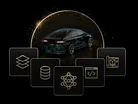
NVIDIA's Alpamayo is a collection of open AI models, simulations tools and datasets which are designed to speed up development of safer, reasoning-based autonomous vehicles (AVs).
Alpamayo's particular focus is on ensuring AVs can overcome rare events using vision language action models (VLAs).
VLAs reason over complex driving scenes, verbalise decision logic and support interpretable and auditable autonomy.
NVIDIA is the first company to release an open reasoning VLA model designed to tackle such events.

About Alpamayo 1
NVIDIA says the systems contained in Alpamayo 1 aim to bring human-like thinking to AV decision making.
It introduces reasoning based on VLA models, which help AV systems through rare and complex situations step by step.
Most traditional AV systems separate perception and planning. As a result they have limited scalability when vehicles are faced with new or unplanned situations.
Unlike perception-only systems, Alpamayo empowers vehicles to explain why they act.
The system does not run directly in AVs. Instead, the models serve as larger scale 'teacher' models that software developers can run to distil the core of their AV systems.
The technology is underpinned by NVIDIA's Halos safety system, a full stack safety system that combines vehicle architecture, AI models, chips, software and tools to ensure safe development of AVs.
Alpamayo 1 also includes simulation tools and data sets for AV development.
The most downloaded robotics model
Alpamayo 1 is open source and its datasets are available on Hugging Face.
Hugging Face is a New York based, open-source AI platform and community where users can share, discover and collaborate on machine learning models, datasets and applications.
Alpamayo 1 is now Hugging Face's top-downloaded robotics model with 100k downloads and rising.
Matt Cragun, Director of Product Management for Autonomous Vehicles and Simulation, said on LinkedIn: “This is exciting. Alpamayo is off to a great start.
“We've gotten lots of great feedback from the community that is helping us make it even better. More to come..."
Reasoning in autonomous vehicles
Many companies in the mobility industry have already taken an interest in Alpamayo to develop their reasoning based AVs. These include Berkeley DeepDrive, JLR and Uber.
Sarfraz Maredia, Global Head of Autonomous Mobility and Delivery at Uber, says: “Handling long-tail and unpredictable driving scenarios is one of the defining challenges of autonomy,”
“Alpamayo creates exciting new opportunities for the industry to accelerate physical AI, improve transparency and increase safe level 4 deployments.”
Lucid, a manufacturer of advanced EVs, partnered with NVIDIA in 2025 to deliver passenger vehicles with Level 4 autonomous driving capabilities.
Kai Stepper, Vice President of ADAS and Autonomous Driving at Lucid Motors, says: “The shift toward physical AI highlights the growing need for AI systems that can reason about real-world benevolence, not just process data.
“Advanced simulation environments, rich datasets and reasoning models are important elements of the evolution.”
NVIDIA says that future models in the Alpamayo family will feature larger parameter counts and more detailed reasoning capabilities. These models will also have more input and output flexibility expanding options for commercial use.
Jensen Huang, Founder and CEO of NVIDIA, says: “The ChatGPT moment for physical AI is here, when machines begin to understand, reason and act in the real world.
“Robotaxis are among the first to benefit. Alpamayo reasoning to autonomous vehicles, allowing them to think through rare scenarios, drive safely in complex environments and explain their driving decisions, it's the foundation for safe, scalable autonomy.”
Company portals



Executives
Jensen Huang
Founder and CEO
Kay (Kai) Stepper
Vice President, Head of ADAS and AD
Sarfraz Maredia
President, Autonomous Mobility & Delivery