
What is Ford’s Universal Electric Vehicle Platform?
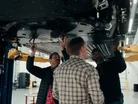
Ford Motor describes its Universal Electric Vehicle (UEV) platform as the system that will enable it to deliver a new generation of affordable EVs at scale.
The first breakthrough product off the UEV platform, a mid-size pickup with few details made public, is on its way to production, the company says.
Ford has had setbacks in EV production, recording a US$19.5bn writedown to close some EV related investments as well as altering some EV production.
With its UEV platform, Ford is looking to reshape the profitability of its EV output and compete on a global scale with other manufacturers.

The first vehicle on the platform
The Wall Street Journal reported that Ford is aiming for a 2027 launch and a price tag of around US$30,000 on the midsize pickup, the first of Ford’s UEV platform.
It added that the vehicle could travel around 300 miles on a single charge and features in-car technology that competes with offerings from both Tesla and China.
It is reported that the vehicle is set to be nearly as fast as a Ford Mustang.
What is so different about the platform?
Ford CEO Jim Farley said during a ceremony at Ford’s Louisville Assembly Plant in 2025 that the UEV platform “represents the most radical change on how we design and how we build vehicles at Ford since the Model T".
While Ford recorded a US$19.5bn charge related to EV investments in 2026, with the company scaling back EV plans and revising some production, its UEV platform seeks to provide the company with radical changes.
The Wall Street Journal reported that with its new truck, Ford has eliminated thousands of feet of heavy copper wiring, cut out hundreds of parts and made it 15% more aerodynamic than its other pickups.
Who is behind Ford's UEV platform?
Alan Clarke, Vice President of Advanced Development Projects at Ford, has led the California-based Advanced Electric Vehicle Development team that created Ford’s UEV platform.
Alan came to Ford from Tesla where he was Director of New Programs Engineering, working on the Model S and Cybertruck.
Writing about the UEV platform in February of 2026, Alan said: “If we succeed, we will have a family of vehicles that we expect to compete on price with the best in the world, including gas vehicles.
"There’s still a lot of work to do, but we’re making progress and we can’t wait to share more soon.”
Manufacturing changes
For production of vehicles on Ford’s UEV platform, a key part has been reshaping the assembly line. The first vehicle is being manufactured at Ford’s Louisville plant ahead of the first vehicle launch in 2027.
Bryce Currie, Chief Manufacturing Officer at Ford and Vice President of Americas Manufacturing, said in an interview on Ford’s website: “Simply put, we’re transforming the traditional assembly line into an ‘assembly tree’. Instead of one long conveyor, three sub-assemblies run down their own lines simultaneously and then join together.
“One sub-assembly is for the front of the vehicle, another for the rear, and the third for the structural battery, seats, consoles and carpeting.”
“We’re confident this is the first time a vehicle will be built like this anywhere in the world. We tore up the century-old concept of the moving assembly line, transforming it with three sub-assemblies and a process that presents the vehicle to operators as a kit.”
Ford’s EV bet
Vehicles built on Ford’s UEV architecture seek to lower costs and simplify systems. With that, Ford is looking to build cars that can compete with Chinese manufacturers on a global scale.
Alan wrote on Ford’s website: “Our big bet for electric vehicles? Obsessing over the vehicle as a system to get more miles out of a smaller battery and radically simplifying the system to reduce the number of parts so we can deliver a new family of affordable electric vehicles to driveways around the world.”
Vehicle manufacturers in China are well known to be able to produce cars quicker and more cost effectively than American or European counterparts. BYD currently dominates the EV market and overtook rival carmakers in 2026 to become the best selling EV brand.
Company portals

Executives
Alan Clarke
Executive Director Advanced EV Development
Bryce Currie
Vice President - Americas Manufacturing, Global MP&L, Manuf. Eng - Company Officer - Ford Motor
Jim Farley
Chief Executive Officer