
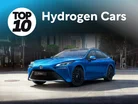
Hydrogen cars, also known as fuel cell vehicles or FCEVs, are easier and faster to refuel than BEVs and PHEVs.
They produce zero emissions when driving, only emitting water as a byproduct.
According to a report from McKinsey, the transportation sector depends almost entirely on fossil fuels and creates more than 20% of all CO₂ emissions.
FCEVs have made various leaps forward in both range and utility and are likely to continue over the next decade as technology advances.
EV Magazine has ranked ten of the top hydrogen cars looking at each vehicle's statistics, innovations and range.
10. Riversimple Rasa
Company: Riversimple
Director: Hugo Spowers
Headquarters: Llandrindod Wells, Wales
With 0 to 60 mph in 9.7 seconds, the Riversimple Rasa can cruise at 60 mph. It can run for 300 miles on 1.5kg of hydrogen and weighs 655 kg.
While not yet commercially available, the Rasa has been developed by a team in Wales.
Riversimple is led by company founder Hugo Spowers, who left a career in motorsports while concerned about the environmental impact of racing.
The company intends to follow up the Rasa with a light commercial delivery vehicle.
9. INEOS Grenadier FCEV
Company: INEOS
CEO: Lynn Calder
Headquarters: London, UK
The INEOS Grenadier FCEV uses 4X4 uses BMW Group’s hydrogen fuel cell powertrain and was developed in partnership with Austrian engineering consultancy AVL.
The production Grenadier FCEV is identical to INEOS’s ICE Grenadier apart from a bonnet power bulge to accommodate the additional height of the fuel cell
Lynn Calder, CEO of INEOS Automotive, says: “INEOS produces 400,000 tonnes of hydrogen per annum and is committed to hydrogen as a key fuel of the future. The hydrogen powered Grenadier Demonstrator is an extraordinary vehicle, capable of doing everything a conventionally powered Grenadier can do but with zero emissions.”
8. Hyundai N Vision 74
Company: Hyundai
CEO: José Muñoz
Headquarters: Seoul, South Korea

With two hydrogen fuel tanks on the rear axle and a fuel cell stack on the front axle, the Hyundai N Vision 74 offers fast refuelling and a long driving range of over 600 km.
The high-performance hydrogen electric hybrid is designed to balance aerodynamics and cooling.
With a tank capacity of 4.2 kg and a fuel cell stack of 85 kW, the car has a max speed of more than 250 km per hour.
While not yet commercially available, Hyundai says the advanced technologies and design possibilities of N Vision 74 could be reflected in its mass production model.
7. Maxus Euniq 7
Company: SAIC
CEO: Wang Xiaoqiu
Headquarters: Shanghai, China
SAIC Motor's Maxus EUNIQ 7 was the world's first hydrogen powered MPV. It officially rolled off the assembly line in June 2020.
SAIC is one of the first Chinese companies to develop fuel cell vehicles. The vehicle is equipped with its third generation fuel cell technology.
A key player in the Chinese hydrogen fuel cell market, SAIC has obtained 511 fuel cell related patents and participating islands have been involved with related fuel cell production since 2001.
6. Changan Deepal SL03
Company: Changan
CEO: Zhu Huarong
Headquarters: Chongqing, China
China’s first large scale produced hydrogen fuel cell sedan was the Deepal SL03.
The SL03 comes in three versions: extended-range version, pure electric version and hydrogen fuel cell electric.
The hydrogen fuel cell electric sedan, with a maximum range of 730 km, has hydrogen consumption per 100 km as low as 0.65 kg, positioning it competitively.
Nearly 50,000 units of the SL03 have been delivered, reaching 215 cities across China.
5. Toyota Crown FCEV
Company: Toyota
CEO: Kenta Kon
Headquarters: Aichi, Japan
The Crown Sedan FCEV is the first Toyota vehicle equipped with a 2.5 litre multi-stage hybrid system.
The engine and two motors, combined with stepped gears, achieve a driving torque that supports acceleration from all speed ranges.
The maximum engine output is available from around 43 km per hour compared to 140 km per hour with existing systems.
The FCEV emits no CO₂ while in operation and accompanies an HEV version of the same car.
4. BMW iX5 Hydrogen
Company: BMW
CEO: Oliver Zipse
Headquarters: Munich, Germany
From 2028, the BMW iX5 Hydrogen will be the brand’s first-ever series-produced hydrogen-powered model.
BMW iX5 Hydrogen began with a global pilot fleet that was on the road in more than 20 countries from 2023.
The car contains a third-generation fuel cell system co-developed with Toyota.
Joachim Post, Member of the Board of Management of BMW AG responsible for Development, says: “By launching the new BMW X5 with a choice of five drivetrain variants, we are once again demonstrating our leading position as a technology pioneer.
“Hydrogen has an essential part to play in global decarbonisation, which is why we are committed to driving the technology forward.”
3. Hyundai NEXO
Company: Hyundai
CEO: José Muñoz
Headquarters: Seoul, South Korea

The Hyundai NEXO delivers 190 kW total output and projected driving range of 826 km.
The NEXO was developed to cold-start at temperatures as low as minus 30 C for low temperature operability.
Powered by a second-generation hydrogen fuel cell system, the vehicle's hydrogen is stored in three tanks for extra security in the event of a collision.
The car features autonomous driving capabilities like remote parking and other convenience features such as blind spot view monitor.
Like Hyundai Motor’s BEVs, NEXO incorporates a vehicle-to-load function, allowing users to power electronic devices both inside and outside the vehicle
Thomas Schmid, Chief Operating Officer of Hyundai Motor Europe, says: “Hyundai Motor is already market leader in fuel cell technology across Europe. Over 70% of all fuel cell cars driving in Europe are made by Hyundai.
“The All New NEXO is an essential step in our eco car strategy to launch 18 new eco cars globally until 2025. It reflects our strong commitment in clean future mobility.”
2. Honda CR-V e:FCEV
Company: Honda
CEO: Toshihiro Mibe
Headquarters: Tokyo, Japan
The new Honda CR-V e:FCEV was the first vehicle to combine plug-in capability with FCEV technology in North America.
With a power output of 92.2 kW and a battery capacity of 17.7 kWh, the CR-V e:FCEV has a driving range of 270 miles. Its fuel cell was co-developed with General Motors.
The CR-V e:FCEV is built at Honda’s Performance Manufacturing Centre in Marysville, Ohio and is the only fuel cell electric passenger vehicle made in America.
Mamadou Diallo, Senior Vice President of Auto Sales of American Honda Motor Co, says: “Leveraging Honda fuel cell technology expertise continues to play a critical role in our global goal to achieve carbon neutrality for all products and corporate activities by 2050.
“Honda has laid out an electrification strategy leading to 100% zero-emission automobile sales by 2040, including the introduction of both battery-electric and fuel cell electric vehicles like this new CR-V e:FCEV model.”
1. Toyota Mirai
Company: Toyota
CEO: Kenta Kon
Headquarters: Aichi, Japan
Toyota's Mirai takes its name from the Japanese word for future.
The second generation Mirai follows the release of the first-generation hydrogen powered sedan, which was released in 2014 and sold 10,000 models globally.
This new model has a driving range of up to 400 miles, improving on the previous model’s range by 30%.
The car features compressed hydrogen fuel stored in three 10,000 psi carbon-fibre reinforced high-pressure tanks. One is mounted in the centre of the car, another under the rear seat and a third below the battery.
These three tanks together hold about 11 pounds of hydrogen.
Yoshikazu Tanaka, Toyota's Mirai Chief Engineer, says: "We have pursued the goal of making a car that customers will feel they want to drive at all times, a car that has an emotional and attractive design and the kind of dynamic and responsive performance that can bring a smile to the driver’s face.
“I want customers to say, ‘I chose the Mirai not because it’s an FCEV, but because I love how it looks and performs; it just happens to be an FCEV'."







Executives
Hugo Spowers MBE
Company Architect and MD

José Muñoz
CEO

Kenta Kon
Chief Financial Officer and Operating Officer at Woven by Toyota
Lynn Calder
CEO, INEOS Automotive

Oliver Zipse
CEO

Toshihiro Mibe
CEO

Wang Xiaoqiu
Chairman

Zhu Huarong