
Top 10: EV Battery Companies
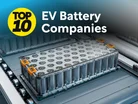
Countries and automakers are looking to move away from ICEs, but without batteries this transition is impossible.
The International Energy Agency predicts that demand for EV batteries will increase at least seven times by 2035.
New technologies, like solid state batteries and extreme fast charging, are being developed by battery manufacturers to make the transition smoother.
EV Magazine has ranked 10 of the top EV battery companies by market cap.
10. Solid Power
CEO: John Van Scoter
Headquarters: Colorado, US
Founded: 2011
Market cap: US$1.03bn
Solid Power is a leading developer of all-solid-state battery (ASSB) technology specifically designed for EVs.
Its business model focuses on developing battery cell designs, producing specialised solid electrolyte material and licensing its technology to automotive and battery partners including Samsung SDI and BMW Group.
Solid Power’s batteries replace the flammable liquid electrolyte found in typical lithium-ion batteries with a proprietary sulphide-based solid electrolyte.
This can help to improve safety, increase energy density and reduce costs.
John Van Scoter, President and CEO of Solid Power, says: “Our solid electrolyte technology is designed for stability and conductivity, and by working closely with global leaders in automotive and battery innovation, we strive to bring ASSB technology closer to widespread adoption.”
9. Microvast
CEO: Yang Wu
Headquarters: Texas, US
Founded: 2006
Market cap: US$1.07bn

Microvast designs and manufactures complete battery systems, including cells, modules and packs tailored for different vehicle requirements.
It uses several chemistries to address different performance needs, including Lithium Titanate Oxide (LTO) for ultra-fast charging and longevity, Nickel Manganese Cobalt (NMC) for high energy density and Lithium Iron Phosphate (LFP) as a cost-effective solution.
It is also developing True All-Solid-State Battery (ASSB) technology using a bipolar stacking architecture that enables internal series connections within a single battery cell.
Microvast is vertically integrated, controlling the entire production process from raw materials to finished battery packs.
8. Amprius Technologies
CEO: Tom Stepien
Headquarters: California, US
Founded: 2008
Market cap: US$1.25bn
Amprius has developed cells that achieve an energy density of 500 Wh/kg, significantly higher than the batteries currently used in most mass-market EVs.
Its battery technology is capable of extreme fast-charging, reaching an 80% charge in approximately six minutes.
Amprius cells are designed to operate across a wide temperature range and have passed the US Military’s Nail Penetration Test.
While primarily used in aviation, the company has expanded to make batteries for EVs on the road and even robotics.
7. Amara Raja Energy & Mobility
CEO: Jayadev Galla
Headquarters: Tirupati, India
Founded: 1985
Market cap: US$1.78bn

Amara Raja designs and manufactures Lithium-ion battery packs and charging solutions specifically tailored for 2-wheeled and 3-wheeled EVs.
The company is transitioning from being just a battery pack assembler to a full-scale cell manufacture with an investment of more than US$1bn to establish the Amara Raja Giga Corridor in Telangana, India.
This Corridor will have a capacity of 16 GWh for cells and 5 GWh for battery packs.
The first phase of the main Gigafactory, with a 3 GWh capacity, is set for a commercial rollout by the end of FY2026.
6. Exide Industries
CEO: Avik Roy
Headquarters: Kolkata, India
Founded: 1947
Market cap: US$3.26bn
Through its subsidiary Nexcharge, Exide Industries manufactures lithium-ion battery packs and modules for a variety of EV segments including two-wheelers, three-wheelers and commercial vehicles.
It operates a 1.5 GWh fully automated lithium-ion assembly plant in Prantij, India and is setting up a Gigafactory in Bengaluru through Exide Energy Solutions Limited.
This facility focuses on manufacturing cells using NMC and LFP chemistries, with the 6 GWh first phase expected to begin commercial production in 2026.
Exide has also signed an MOU with Hyundai Motor Company and Kia Corporation to equip EVs in the Indian market with locally produced LFP batteries.
5. QuantumScape
CEO: Siva Sivaram
Headquarters: California, US
Founded: 2010
Market cap: US$6.24bn
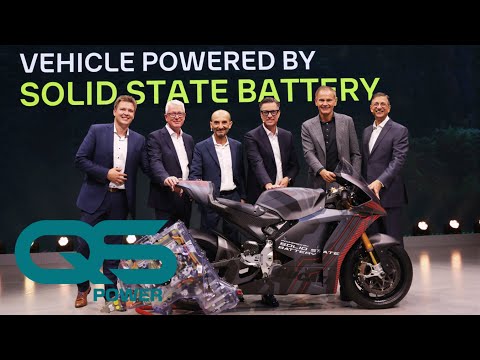
QuantumScape is developing solid-state lithium-metal batteries specifically designed for EVs and is transitioning from research and development to commercial-scale manufacturing.
The company’s primary product replaces the liquid electrolyte and polymer separator found in conventional lithium-ion batteries with a proprietary solid ceramic separator.
This technology allows for the use of a lithium-metal anode, which significantly increases energy density.
QuantumScape's first planned commercial product is called the QSE-5, designed to offer a combination of high energy density, fast charging and enhanced safety.
The company has a long-standing partnership with Volkswagen Group.
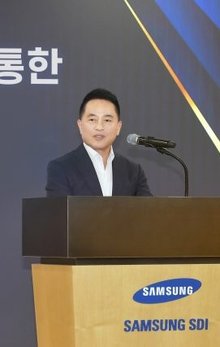
4. Samsung SDI
CEO: Choi Yoon-ho
Headquarters: Yongin, South Korea
Founded: 1970
Market cap: US$15.16bn
Samsung SDI is a specialist in prismatic battery cells known for their durability and efficient heat dissipation.
The company is developing all-solid-state battery technology, which replaces the liquid electrolyte with a solid one to increase energy density and improve safety.
It has established a roadmap for mass production of this technology by 2027.
Samsung SDI operates a global network of production facilities for EV batteries, with major manufacturing hubs located in South Korea, China, Hungary and the US.
In December 2025, the company signed an MOU with automaker KG Mobility to jointly develop next-generation battery pack technologies for EVs.
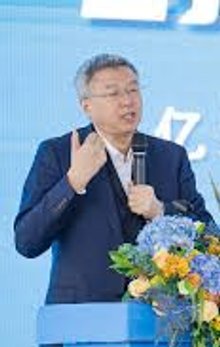
3. EVE Energy
CEO: Liu Jianhua
Headquarters: Huizhou, China
Founded: 2001
Market cap: US$19.81bn

Founded in 2001, EVE Energy produces a wide variety of battery cells and systems tailored for different types of electric transportation including passenger cars, commercial vehicles and electric ships.
EVE has formed partnerships with a variety of businesses including Daimler, ABB and SK Innovation.
Alongside prismatic LFP and NCM technologies, the company makes pouch NCM cells with flexible film packaging and cylindrical cells with a full tab structure.
Its large cylindrical battery has provided more than a thousand kilometres of real-world range on a single charge in a BMW iX3, setting a new efficiency record for BMW Group.
EVE develops its own battery management systems, compatible with OEM requirements, to ensure the safety and efficiency of its battery packs.
It also has a dedicated recycling division to recover valuable materials from end-of-life batteries.
2. LG Energy Solution
CEO: Kim Dong-myung
Headquarters: Seoul, South Korea
Founded: 2020
Market cap: US$62.58bn
LG Energy Solution specialises in pouch-type batteries and cylindrical batteries for the EV market alongside using high-performance chemistries like NCMA (Nickel, Cobalt, Manganese, Aluminum).
It has a five-region production footprint with manufacturing plants in South Korea, the US, China, Poland and Indonesia.
LG Energy Solution has established a variety of joint ventures with automotive OEMs including General Motors, Honda, Stellantis and Hyundai Motor Group.
Beyond current lithium-ion technology, the company is actively researching next-generation batteries including all-solid-state batteries and lithium-sulfur batteries to improve safety and performance.
In partnership with startup South 8 Technologies, the company is also developing space-rated batteries that can function at ultra-low temperatures alongside NASA and KULR Technology Group.
This collaboration will use South 8’s liquefied gas electrolyte technology to create lithium-ion batteries that could be used in future space exploration.
1. CATL
CEO: Robin Zeng
Headquarters: Ningde, China
Founded: 2011
Market cap: US$236.78bn

While CATL was not officially founded until 2011, its much of its leadership and expertise evolved from ATL, a world leader in lithium-ion batteries for consumer electronics like smartphones and laptops.
CATL was created specifically to focus on battery systems for EVs and has maintained the number one ranking in global EV battery usage since 2017.
It has established long-term strategic partnerships and joint ventures with companies including BMW, Stellantis, Tesla, SAIC, Geely, GAC Group and JAC Group.
CATL is also active in the battery-as-a-service market, providing solutions to reduce range anxiety and initial EV purchase costs.
It has 13 production bases globally, including in Germany and Hungary.
In Sichuan, China, the company’s Yibin plant achieves highly automated battery manufacturing and can create a cell in one second.
The plant uses local hydropower for 80% of its energy alongside electric logistics and recycling to achieve carbon neutrality.
Company portals






Executives
Avik Roy
Managing Director & CEO
Choi Yoon-ho
CEO

Jayadev Galla
CEO

John Van Scoter
President and CEO

Kim Dong-Myung
Director
Liu Jianhua
CEO
Siva Sivaram
President & CEO
Tom Stepien
CEO
Yang Wu
CEO
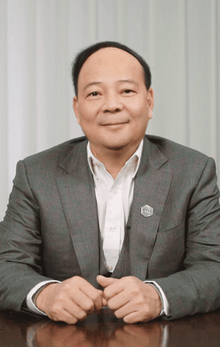
Zeng Yuqun (Robin Zeng)
CEO