
Volvo’s Electric Truck Fleet Travels 250 Million Kilometres
Heavy-duty transport remains one of the most challenging sectors to decarbonise, accounting for approximately 5% of global CO₂-equivalent emissions according to the World Economic Forum.
Every electrified kilometre helps to reduce this impact.
Since introducing its first battery-electric trucks in 2019, Volvo Trucks’ electric fleet has collectively travelled more than 250 million kilometres in commercial traffic worldwide.
That distance – equivalent to more than 6,200 laps around the globe – demonstrates how the electrification of heavy transport is advancing from pilot projects to proven large-scale operations.
“It’s great to see this development and how transport companies are embracing the benefits from using electric trucks in daily operations. Electric trucks are cutting emissions and providing a more comfortable and quieter working environment for drivers,” says Roger Alm, President Volvo Trucks.
“Still, we all know that the shift to electric is going way too slowly. We lack the market conditions that would make it profitable for all transport companies to decarbonise transport. This must change if we are to see more electric trucks on the road.”
Decarbonising commercial traffic
Electric trucks can play a pivotal role in cutting carbon emissions across global logistics networks.
Replacing diesel-powered trucks with electric alternatives for the same 250 million kilometres would have required more than 78 million litres of fuel.
Instead, operators using Volvo’s electric trucks have collectively avoided around 213,000 tonnes of tailpipe CO₂ emissions.
Beyond emissions reductions, the quieter operation and lack of exhaust fumes contribute to improved urban liveability, especially in cities where low-emission zones are tightening around delivery routes.
Decarbonising commercial traffic extends beyond clean vehicles themselves. It includes integrating renewable energy for charging, optimising route planning and supporting grid stability through managed charging infrastructure.
As governments and logistics companies race toward net zero targets, the growing adoption of electric trucks creates a tangible shift in the economics of sustainable freight.
Volvo’s electric truck line-up
Volvo offers eight electric truck models tailored to diverse transport needs. These include the Volvo FL Electric and FE Electric for urban distribution and waste collection, the FM Electric and FM Low Entry designed for regional haulage, the FMX Electric for construction and the flagship FH Electric and FH Aero Electric for long-haul transport.
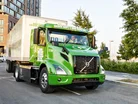
In North America, the Volvo VNR Electric serves regional freight operators who demand reliability and rapid charge turnaround.

Each model builds on Volvo Trucks’ decades of experience in powertrain engineering and fleet management. The company’s expertise in optimising the use of installed energy, streamlining charging strategies and servicing electric drivetrains has positioned it as a leader in sustainable heavy transport solutions.
Looking ahead, Volvo plans to expand its range further.
In 2026, it will launch a new heavy-duty electric truck delivering up to 600 kilometres per charge – extending zero-emission transport into routes previously dependent on diesel.
The demand for commercial EVs
Volvo’s electric trucks are now a familiar sight across major freight markets. Germany, the Netherlands, Norway, Sweden and the United States have emerged as the strongest adopters, propelled by supportive infrastructure and progressive emission-reduction policies.
The milestone also speaks to Volvo’s operational maturity when it comes to electrification.
Since 2019, its vehicles have not only proven reliable across diverse climates and applications but have also generated real-world data to inform future innovation.
From heavy logistics to construction and municipal services, Volvo’s customers are demonstrating that electrification enhances efficiency without compromising performance.
Dual-track decarbonisation strategy
Volvo Trucks’ approach to achieving climate neutrality by 2040 is multi-pronged.
Alongside its battery-electric line-up, the company continues research and production of fuel-cell electric trucks powered by hydrogen, and combustion engines that run on renewable fuels such as biogas and hydrogen.
This parallel development ensures that customers across different regions – where energy infrastructure may vary – can still transition away from fossil fuels effectively.
By combining immediate, scalable battery-electric technology with the long-term potential of hydrogen-based powertrains, Volvo aims to accelerate the transport industry’s progress towards net zero emissions.
Company portals

Executives

Roger Alm
President - Volvo Trucks