Shaping the EV Future: KINTO’s Net Zero Workshop
The automotive industry is advancing more rapidly than most sectors in its transition towards net zero emissions, presenting both opportunities and challenges for leaders managing fleet operations and transport strategies.
Electrification continues to accelerate, battery innovation is advancing at pace and hydrogen mobility is gaining momentum as manufacturers rethink how vehicles are designed, built and used.
Simultaneously, tightening regulations and rising consumer expectations are forcing organisations to decarbonise across the value chain.
These shifts are creating a complex landscape for fleet managers and sustainability professionals tasked with delivering measurable emissions reductions whilst maintaining operational efficiency.
Understanding how to navigate this transformation has become essential for organisations committed to credible climate action.
At Sustainability LIVE: The Net Zero Summit, The Future of Net Zero Automotive workshop, led by KINTO, will offer practical insight into how automotive organisations can scale sustainable solutions whilst managing supply chain complexity and evolving policy demands.
The session is designed for sustainability leaders, fleet managers and supply chain professionals looking to understand the technologies, frameworks and partnerships shaping the sector's net zero journey.

Technology trends
Electrification, next generation battery systems and hydrogen mobility are they are transforming the automotive landscape today.
For fleet managers evaluating vehicle procurement strategies, staying informed about these technologies is essential to building credible long-term transport roadmaps.
The workshop will explore the infrastructure developments and innovations that are redefining mobility and creating new opportunities for emissions reduction at scale.
As corporate fleets represent a significant proportion of business transport emissions, understanding which technologies can deliver both performance and sustainability outcomes has become a strategic priority.
According to KINTO, these technological shifts are enabling organisations to rethink their approach to fleet management entirely.
The company says that understanding the practical applications of emerging technologies is critical for sustainability teams seeking to make informed procurement decisions.
For professionals navigating this landscape, staying abreast of battery performance improvements, charging infrastructure expansion and hydrogen fuel cell developments has become essential to maintaining competitive and sustainable fleet operations.
Supply chain emissions
Automotive emissions extend far beyond tailpipes.
Supply chain activity, material sourcing and manufacturing processes account for a significant share of the sector's carbon footprint, making Scope 3 reduction a critical challenge for sustainability leaders.
KINTO's session will discuss strategies for reducing emissions across complex supplier networks, helping organisations address one of the most challenging areas of net zero delivery.
For professionals involved in sustainable procurement and value chain decarbonisation, this discussion will provide practical value in navigating supplier engagement and emissions reporting.
The complexity of automotive supply chains means that emissions reduction requires collaboration across multiple tiers of suppliers.
As reporting standards evolve and Scope 3 disclosure becomes mandatory under frameworks such as the Corporate Sustainability Reporting Directive (CSRD), organisations need robust methodologies for tracking and reducing supply chain emissions across their operations.
Regulation and market expectations
Policy frameworks are accelerating the pace of transformation across the automotive value chain, with reporting requirements and compliance standards tightening across Europe and beyond.
At the same time, consumer demand and stakeholder expectations are shifting rapidly towards low-emission, flexible transport models.
The workshop will examine how regulation and market pressure are driving industry change, offering insight into what sustainability teams and fleet managers must prepare for next.
Understanding these dynamics is increasingly important for organisations navigating CSRD requirements and environmental, social and governance (ESG) disclosure obligations.
Regulatory timelines are compressing, with phase-out dates for internal combustion engines approaching in multiple markets.
This creates urgency for fleet managers to develop transition strategies that align with both policy requirements and organisational sustainability commitments.
Consumer expectations are also evolving, with employees and stakeholders increasingly prioritising organisations that demonstrate credible climate action.
For corporate fleets, this means that vehicle choice and mobility strategy are becoming visible indicators of sustainability leadership.
Scaling sustainable fleet solutions
Sustainability leadership is increasingly about implementation.
Organisations need proven models that can move beyond pilot programmes and deliver measurable impact at scale across corporate fleets.
KINTO, Toyota's global mobility brand, positions itself as an enabler of shared, electrified and data-driven transport aligned with Europe's net zero ambitions.
Through services such as KINTO One, an all-inclusive leasing solution, the company says it has supported corporate fleets in transitioning to electrified mobility, with more than 95% electrification in some markets, according to KINTO.
Attendees will gain grounded insight into scaling sustainable mobility solutions that deliver operational and emissions performance, a critical consideration for fleet managers balancing cost, usability and carbon targets.
As ownership gives way to usership, mobility is becoming more flexible, connected and sustainability-led.
KINTO's wider ecosystem includes platforms such as KINTO Join, promoting greener commuting through verified low-carbon journeys, and KINTO Zero, offering ESG consultancy, carbon accounting and CSRD-aligned reporting.
With digital tools that track CO₂ performance and fleet utilisation, KINTO says it is strengthening its role as a partner in corporate sustainability transitions.
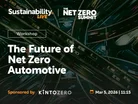
The Future of Net Zero Automotive workshop takes place on 5 March 2026 from 11:15–12:00 GMT in Room 1. Designed for automotive, mobility, sustainability and supply chain leaders, the session could provide practical insight into the innovations, policies and collaborations shaping the future of net zero transport.
Sustainable mobility is becoming a defining pillar of corporate climate strategy. For fleet managers and sustainability professionals navigating this transition, sessions like this could offer an opportunity to learn from sector leaders and gain actionable insights into the road ahead.
About the workshop
The Future of Net Zero Automotive
- Date: 5 March 2026
- Time: 11:15–12:00 GMT
- Location: Room 1
Designed for automotive, mobility, sustainability and supply chain leaders, this workshop will provide practical insight into the innovations, policies and collaborations shaping the future of net zero transport.
Sustainable mobility is becoming a defining pillar of corporate climate strategy.
This session offers an opportunity to learn from one of the sector’s leading mobility brands and gain actionable insights into the road ahead.
Register your interest for KINTO’s Future of Net Zero Automotive workshop today