
Why Is Sustainable Mining Vital for Sandvik's EV Future?
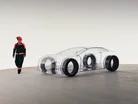
Sandvik has produced the world's first car made with no mined metals or minerals.
The vehicle, named eNimon, is transparent and stationary, serving as a striking visualisation of a world without mining and its direct consequences for the electric vehicle (EV) industry.
More than 90% of the components in a typical EV are derived from mined materials.
Without a continuous and growing supply of these materials, there would be no electric cars, no wind turbines and no solar panels.
Sandvik created the 'no mine car' to highlight the critical role of sustainable mining in achieving global climate goals.
“Sustainable mining is the backbone of the green transition,” explains Mats Eriksson, President at Business Area Mining at Sandvik. “Without it, we can’t meet climate goals.”
The mineral demand of electric vehicles
The transition to electric vehicles is mineral-intensive, as an EV requires approximately six times more mineral resources than a conventional car.
To meet net zero targets by 2050, the world could require up to five times more lithium, nickel and cobalt.
According to the International Energy Agency (IEA), global demand for critical minerals is predicted to triple by 2030 and quadruple by 2040.
To deploy wind, solar and energy storage at the necessary scale, over three billion tonnes of minerals and metals will be needed.
Supplying this demand safely and responsibly requires a move towards more intelligent mining operations.
"There wouldn’t be a green transition without mining," Mats says.
"We want to electrify the world because it makes the world more sustainable."

Digitisation and sustainable mining
Modern mining is undergoing a profound transformation, with underground operations becoming autonomous, electrified and digitised which allows mines to optimise themselves in real time.
Through the continuous collection and analysis of data, companies can improve productivity and reduce energy consumption per tonne.
The use of battery-electric loaders, trucks and drills coordinated by advanced software removes the need for most people to work at the active rock face.
This digital approach provides a live system-wide view of the mine, enabling operators to fine-tune processes from haulage to ventilation.
The result is higher throughput with a reduced environmental footprint, which helps supply the metals that decarbonisation and the EV industry demand.
Bridging the mining skills gap
Despite the soaring demand for critical minerals, the mining sector faces a talent shortage.
Enrolment in mining-related studies is in decline and many graduates are hesitant to pursue careers in the industry.
New global research from Sandvik shows that while only half of engineering students view mining favourably, more than 90% would consider a career in the sector if they better understood its foundational role in the green transition.
To attract the next generation of talent, the industry must demonstrate its commitment to sustainability, from using electrified fleets and recycled water to ensuring transparent reporting and community engagement.
It needs to communicate that today’s mines are high-tech environments where data science, automation and environmental stewardship converge.
The eNimon car is now on display at the National Museum of Science and Technology in Stockholm, Sweden.