
EVs & Hybrids: Hyundai CEO's Vision for the Future
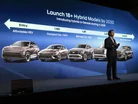
At Hyundai's CEO Investor Day in New York, senior leadership reaffirmed plans to grow its electrified portfolio, aiming for electric models to represent 60% of total sales by 2030.
This move towards electrification is a core component of Hyundai's goal to reach 5.5 million global vehicle sales by the end of the decade.
According to Hyundai, electrified vehicles are expected to account for 3.3 million of these units, with North America, Europe and Korea forecast as key growth markets.
Speaking in New York, CEO José Muñoz said: "In an industry facing unprecedented transformation, Hyundai is uniquely positioned to win through our unmatched combination of compelling products, manufacturing flexibility, technology leadership, outstanding dealer partners and global scale.
“We are delivering comprehensive electrified portfolios across all segments, localising production in key markets and leveraging breakthrough technologies from software-defined vehicles to next-generation batteries.”
An expanding electric and hybrid portfolio
Hyundai's product expansion includes the introduction of more than 18 new hybrid models.
Hyundai's EV strategy also features a region-specific approach to production and design.
This includes the IONIQ 3, a model targeting European mass-market customers with next-generation infotainment systems.
In India, Hyundai is introducing the country’s first EV designed specifically for local drivers, supported by a localised supply chain.
For China, the locally produced Elexio SUV is a new milestone in Hyundai’s commitment to the market.
Hyundai is also developing a distinctive approach to Extended Range EVs (EREV).
Unlike conventional models, Hyundai’s strategy utilises in-house high-performance batteries, which could allow for full EV power with less than half the battery capacity.
These EREV models, planned for a 2027 launch, are being designed to offer a range of more than 965km (600 miles).
Sustainable manufacturing for EVs
Hyundai’s electric ambitions are aligned with its ‘Progress to Humanity’ vision.
Hyundai says that this “reflects our belief that advancing emissions-free mobility is not only sound business, but a shared responsibility to ensure cleaner air, stronger economies, and a better quality of life for future generations".
In its 2025 Sustainability report, José said: “Our commitment to achieving 100% renewable energy (RE100) across our businesses is taking shape through large-scale renewable energy purchase agreements in Korea, the US, and India. We’re also maximizing water recycling and working toward our ultimate goal of carbon neutrality by 2045.”
Manufacturing capabilities are being advanced to support this vision.
José outlined how the Hyundai Motor Group Metaplant America (HMGMA) is set to reach a total production capacity of half a million units by 2028.
By 2030, Hyundai aims to produce more than 80% of vehicles sold in the US domestically, a move that could increase its local supply chain content from 60% to 80%.
The role of luxury brand Genesis
Genesis, Hyundai's luxury brand, is also central to Hyundai’s electrification plans.
Celebrating its 10th anniversary, the brand is strengthening its US-based production and planning EREV launches.

Genesis is also targeting growth in the Middle East, Korea, China and other emerging markets, with the goal of expanding its presence into 20 European markets.
This expansion is part of a strategy for Genesis to reach 350,000 annual sales by 2030.