
How EVs can Support Truly Sustainable Supply Chains
As companies worldwide grapple with Scope 3 reduction targets on the road to net zero, green logistics are becoming increasingly crucial for all industries.
McKinsey estimates that demand for green logistics in 2025 will reach approximately US$50bn, comprising roughly 2% of overall logistics spend, and US$350bn (15%) by 2030.
Green logistics encompasses a comprehensive approach to reducing the environmental footprint of logistics activities, including transportation, warehousing, packaging and distribution.
Ultimately, many businesses aim to make supply chains efficient and sustainable by minimising greenhouse gas emissions, energy use and waste across product lifecycle.
Read the full story in the August 2025 edition of Sustainability Magazine.
Transforming transportation
Transportation remains the largest contributor to emissions within logistics. Consequently, green logistics strategies prioritise transitioning to cleaner transport modes, like EVs, and optimising routes to reduce fuel consumption.
Amazon's workforce ships and delivers approximately 1.6 million packages daily, affecting both packaging and transportation.
"Decarbonising our transport network is key to helping us achieve our goal of reaching net zero carbon emissions across our operations by 2040,” explains Nicola Fyfe, EU VP of Amazon Logistics.
In early 2025, Amazon celebrated its milestone of one billion packages delivered via EVs in the US as Chief Sustainability Officer Kara Hurst explains.
"It couldn't have happened without the incredible delivery associates and more than 20,000 electric vans now delivering to customers in thousands of cities from coast to coast," she celebrated.
"Our one billionth delivery didn't arrive with a big red bow, so the customer probably didn't know the difference. But, that's the point. We want every customer to experience reliable and fast delivery, regardless of the changes we're making behind the scenes.
"Every new EV signals an important shift and we're on our way to hitting our goal of at least 100,000 electric delivery vans on the road by 2030."
EVs offer up to 90% fewer greenhouse gas emissions compared to internal combustion engine (ICE) vehicles, with up to 80% savings in fuel expenses and up to 70% lower maintenance costs, thus redefining cost-efficiency in logistics.
- 2020: Amazon ordered 1,800 electric Mercedes-Benz vans for its European fleet, with 500 dedicated to the UK.
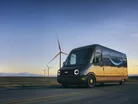
- 2022: Custom electric delivery vans, developed in partnership with Rivian, began deployment. Amazon aimed to deploy 10,000 Rivian vans by the end of the year, with an ambitious goal of 100,000 by 2030.
- 2023: By October, Amazon reported having 10,000 Rivian electric vans actively delivering across the US.
- 2025: Amazon celebrates one billion parcels delivered by an EV in the US.
Warehouse optimisation
Beyond transportation, warehousing is another area where adopting sustainable practices can reduce environmental impacts. Modern sustainable warehouses look to integrate energy-efficient designs, employ renewable energy sources and use smart technologies to improve energy efficiency.
With no fewer than 255 million customers visiting its stores every single week, Walmart must ensure its vast operations run as smoothly as possible.
It's why the retail giant is prioritising high-tech consolidation centres and warehouses within its supply chain infrastructure.
“We’ve made continued investments in our people, facilities and technology to ensure we have the right product, in the right place, at the right time,” says Mike Gray, Senior VP of Ambient Operations at Walmart.
The company's consolidation centres support efficient product movement, allowing suppliers to send smaller freight loads — known as less-than-truckload (LTL) — which are then consolidated into larger freight loads, or truckloads (TL), optimise logistics flow to stores.
Packaging innovation and waste reduction
The issue of packaging waste remains significant within logistics, particularly with the growing e-commerce sector. In response, companies are innovating with sustainable packaging materials, redundant packaging reduction and promoting recycling and reuse.
When it comes to packaging, Unilever has a three-pronged approach:
- Reduction – using less virgin plastic
- Circulation – more recyclable, reusable, compostable packaging
- Collaboration – a collective effort on plastic
The consumer goods giant – which looks after around 400 brands, including Dove, Knorr and Hellmann's – has enjoyed impressive results, reducing its use of virgin plastic by 23% since 2019. More than a fifth (21%) of its global product portfolio now uses recycled plastic.

Unilever is also a key advocate for the Global Plastics Treaty. It’s hoped the treaty will be finalised in 2025 after interested parties failed to reach an agreement last year.
- Reduce virgin plastic footprint by 30% by 2026 and 40% by 2028 – 23% reduction compared to 2019
- 100% of plastic packaging to be reusable, recyclable or compostable – by 2030 (for rigids) and 2035 (for flexibles). 57% of total packaging is recyclable, reusable or compostable (76% rigids, 13% flexibles)
- Use 25% recycled plastic in packaging by 2025 – 21% in 2024
- Collect and process more plastic packaging than it sells by 2025 – 93% in 2024
Rebecca Marmot, Chief Sustainability Officer at Unilever, said: "We were hoping — and have worked extensively — for an international legally binding instrument that would harmonise the policy landscape, strengthen national legislation and help businesses scale proven solutions for priority sectors, such as packaging.”
Technology for visibility and efficiency
Advanced technologies like AI, the Internet of Things (IoT) and cloud-based platforms can offer significant improvements in logistics by delivering real-time data for optimising operations.
"You can't predict disruption, but what you can do is be set up and work with a partner like Coupa who can help you react quickly," explains Bill Wardwell, General Manager and SVP of Payments, Treasury and Supplier Services at Coupa.
"It's all about how you react and react quickly. The tech we provide at Coupa makes customers both faster and better."
Coupa offers a multiagent AI portfolio of solutions packed full of new innovations that will enhance decision-making, streamline processes and boost productivity – giving teams more time for strategic work – along with powering faster insights and better outcomes.
"Coupa is transforming global trade by using multiagent AI capabilities to dynamically and autonomously match the needs of buyers and suppliers,” says Salvatore Lombardo, Coupa’s Chief Product and Technology Officer.
“Agentic AI will redefine our user experience, unlocking insights and amazing customer outcomes.”
Emerging technologies such as autonomous electric delivery vehicles, drone deliveries and blockchain for supply chain transparency promise to further enhance sustainability.
As Rebecca says, “the sustainability landscape has changed”.
She adds: “Tackling complex challenges requires innovation, collaboration beyond our own value chains and aligning business growth with government priorities to build resilient, future-fit businesses and economies.”
Read the full story in the August 2025 edition of Sustainability Magazine.