
Could the US-EU trade Deal Raise Costs for EV Exporters?
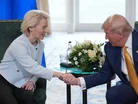
The recent trade deal between the United States and the European Union, unveiled by US President Donald Trump and European Commission President Ursula von der Leyen, is poised to have a notable impact on the EV sector as it reshapes transatlantic economic relations.
Announced after discussions at President Trump’s golf resort in Scotland, the agreement introduces a 15% tariff on most European goods entering the US, while requiring the EU to significantly increase its investment in American energy and defence products.
These changes are rippling through multiple industries, influencing how EV manufacturers conduct business across borders.
While many view the deal as favouring US interests by creating clear economic benefits, European nations are faced with increased costs and the need to realign their trade strategies to accommodate these new tariffs.
The deal's structure is perceived by some industry leaders as imbalanced, benefiting US exporters at the expense of their European counterparts.

Tariffs and their effect on EV exports
Central to the agreement is a unified 15% tariff on goods from the European Union entering the United States.
Though lower than the initially proposed 30%, this rate surpasses pre-2024 levels, affecting EU industries' ability to compete in the US market.
As part of the concession for avoiding higher tariffs, Brussels has agreed to spend US$750bn on US oil, gas, nuclear fuel, and semiconductors over three years. An additional US$600bn is earmarked for American industries, reportedly including military equipment investments.
Critics highlight the lack of reciprocity, with Prashant Newnaha from TD Securities says: “A 15% tariff on European goods, forced purchases of US energy and military equipment and zero tariff retaliation by Europe, that’s not negotiation, that’s art of the deal.”
Germany, with its strong automotive sector, bears a significant portion of the trade deal's brunt.
According to Wolfgang Niedermark of the German industrial federation BDI, even a tariff of this magnitude poses substantial challenges for Germany’s export-reliant manufacturing base.
Similarly, the tariff levels are considered too high by the German chemicals trade group VCI.
Volkswagen, for instance, reported a €1.3bn (US$1.5bn) reduction in first-half profits due to the new tariff structure under the trade agreement.
Sector-specific transformations
The trade agreement’s implications differ across various industries.
According to Ursula von der Leyen, certain products are excluded from tariffs, including aircraft and parts, selected chemicals, generic pharmaceuticals, semiconductor equipment, agricultural goods, natural resources and critical raw materials.
Nonetheless, these exclusions still leave some sectors, like the EV industry, grappling with challenges.
The automotive industry now faces a steady 15% tariff on US-bound exports.
Although this is lower than the previous 25% global rate, it adds financial strain on manufacturers, compelling them to modify their supply chains and absorb lower profit margins.
Meanwhile, US carmakers are reaping benefits from a decline in non-tariff barriers, as the EU now recognises US vehicle standards, simplifying access to the European market.
Other sectors, like steel and aluminium, continue encountering hefty tariffs of 50%, with discussions about quota-based solutions still underway.
Wine, spirits and niche goods await further clarity on tariff classifications, leaving exporters uncertain about future pricing structures.
Economic and political ramifications
Beyond economics, the deal impacts political dynamics within the EU and across its borders.
Irish companies are in a unique position as they face the full 15% US tariff, while their Northern Irish competitors under the UK-US agreement only contend with a 10% rate.
This discrepancy reopens discussions about post-Brexit customs, particularly in light of the Good Friday Agreement.
Reactions from political leaders across Europe vary.
France’s Prime Minister Francois Bayrou describes the agreement in sombre terms, stating: “It is a sombre day when an alliance of free peoples, brought together to affirm their common values and defend their interests, gives in to submission.”
Conversely, Italy’s Giorgia Meloni considers the tariff “sustainable,” albeit cautiously awaiting more details.
The agreement shifts away from prior aspirations of eliminating tariffs entirely.
The US is projected to generate around US$90bn annually through the newly levied duties.
EU leaders present the pact as a pragmatic alternative that precludes more severe trade confrontations.
However, analysts argue the EU has sidestepped deeper conflict at a considerable cost.
The European Central Bank describes trade conditions as “exceptionally uncertain,” posing challenges for long-term planning in the EV sector and beyond.
As the costs mount, the verdict on whether this "new era of stability" meets expectations remains open.
Meanwhile, stakeholders in the electric vehicle and mobility sectors are contending with the changes and assessing how benefits balance costs both in Europe and across the Atlantic.