
How Coles is Growing EV Fleets to Cut Supply Chain Emissions
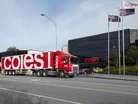
Coles, one of Australia’s biggest retail chains, is placing electric transport and clean energy at the centre of its 2025 sustainability strategy.
With more than 1,800 outlets across the country, the company continues to roll out low-emissions solutions across both its logistics operations and store infrastructure.
The aim is to decarbonise its supply chain, strengthen energy resilience and meet its long-term environmental targets.
Expanding EV freight and delivery operations
A central feature of Coles’ emissions reduction strategy is the introduction of its first electric prime mover truck in partnership with logistics company Linfox.
This heavy-duty electric truck now completes around 25 grocery deliveries each week across Victoria and is projected to reduce emissions by more than 65 tonnes of CO₂e each year when compared with diesel-powered equivalents.
It can travel up to 300km on a single charge and cuts diesel use by approximately 25,000 litres annually.
This step is part of a broader strategy to lower transport emissions.
Coles is also launching a new transport management system known as Manhattan.
It helps optimise freight routes by automatically matching suppliers with the closest available transport partners.
This reduces fuel consumption, travel time and kilometres covered, resulting in fewer transport-related emissions.
The retailer is also reshaping its liquor delivery operations through a partnership with Lion and Asahi.
By consolidating deliveries and removing smaller vehicles from the network, Coles aims to reduce emissions by an additional 300 tonnes of CO₂e annually.
Electric options are also being tested for home delivery.
Between July 2023 and July 2024, Coles trialled a fully electric van, named Sparky, in Queensland. While the trial demonstrated the viability of electric home delivery, the company paused the rollout to address charging infrastructure issues.
The report notes that public charging networks remain limited and "highlighted limitations with public electric vehicle infrastructure in Australia, which is crucial to meeting the needs of a national home-delivery electric fleet."
Coles confirms that “we are also exploring additional transportation strategies including: creating more efficient routes, as part of our planning processes to minimise fuel consumption; improving driver behaviour to avoid rapid acceleration, hard breaking and excessive idling to reduce emissions; enhancing the maintenance of our fleet to keep the vans in good condition to increase fuel efficiency; constantly ‘rightsizing’ our fleet to reduce the overall number of vans.”
Coles also continues to upgrade its online delivery fleet, which now includes more than 200 diesel vans fitted with electric-powered refrigeration units.
These units reduce the environmental footprint of deliveries by replacing petrol-powered systems with more energy-efficient options.
Stores powered by solar and electrified systems
In early 2025, Coles opened a new supermarket and Liquorland in Victoria designed entirely around sustainability features.
The site includes energy-efficient lighting, two EV charging stations, electrified heating and cooling systems and refrigeration that uses natural refrigerants, now used in 104 of its supermarkets.
It also houses the largest solar panel system ever installed on a Coles site.
The 305kW solar system is expected to produce 407MWh of electricity each year, covering about 31% of the site’s total annual electricity needs.
Coles' collaboration with Origin through the Origin Zero Alliance is projected to generate 9,821MWh of renewable electricity annually.
The company has already hit its 2021 target of sourcing 100% renewable electricity by the end of FY25 and confirms it is “committed to maintaining 100%” through its FY26 to FY30 strategy.
“The objective of our climate pillar is to progress towards decarbonisation of our operations and work with our suppliers and partners to reduce emissions to drive a more resilient food system for Australia,” says Peter Allen, Chairman, Coles Group Limited and Leah Weckert Managing Director and Chief Executive Officer, Coles Group Limited in the report.
“This year we met our target to source 100% renewable electricity for our operations.
“We also achieved a 71.4% reduction in combined Scope 1 and 2 GHG emissions (from FY24).”
Sustainable sourcing, packaging and waste reduction
The report details Coles’ partnership with the Great Barrier Reef Foundation (GBRF) to support the world’s largest seagrass restoration nursery.
Three years into a 10-year A$10m (US$6.5m) partnership, the project is focused on restoring coastal wetlands, protecting seagrass meadows and encouraging environmental engagement.
Coles also continues to lead on responsible sourcing, offering 316 RSPCA approved products, the most of any national retailer.
To improve supply chain sustainability, the company is actively working on forest and land management strategies.
In FY25, it set a FLAG (Forest, Land and Agriculture) target validated by the Science Based Targets initiative (SBTi), which includes a no-deforestation commitment.
“All Coles Own Brand timber, pulp and paper products source material from forest plantations independently certified to the Programme for the Endorsement of Forest Certification (PEFC) or Forest Stewardship Council (FSC) certification schemes, or from post-consumer recycled fibre,” the report states.
Coles is also progressing work on palm oil. In partnership with the Rainforest Alliance, the company has begun mapping its Own Brand palm oil supply chain to assess deforestation risks.
As of now, 95% of Coles Own Brand non-food products are RSPO (Roundtable on Sustainable Palm Oil) certified.
To support the remaining 5%, the company buys RSPO ‘book and claim’ credits that support smallholder farmers.
Waste reduction is another priority under Coles’ circularity programme.
Since 2021, more than 600 million pieces of plastic have been removed from Coles Own Brand packaging.
In 2024, 88% of the retailer’s total solid waste was diverted from landfill.
More than 19,655 tonnes of unsold but edible food were donated to SecondBite and Foodbank, helping provide more than 39.1 million meals.
The company further donated 18,960 tonnes of food to farmers, animal sanctuaries and zoos and processed 29,205 tonnes of inedible food into compost.
In addition, 5,796 tonnes of surplus bread were converted into stock feed and pet food through a partnership with Goodman Fielder.
Coles’ rollout of electric vehicles shows how large-scale retail logistics can move towards cleaner, more efficient operations.
From heavy-duty electric trucks to EV-powered delivery vans, the company is reducing fuel use and cutting emissions across its supply chain.
These actions form part of Coles’ broader commitment to decarbonisation and building a more resilient food system for Australia.