Ford, BMW, Renault & Hyundai: This Week's Top EV News


16 March
Ford’s F-150 Lightning uses Extended Range Electric Vehicle (EREV) technology and offers a generator-backed estimated range of more than 700 miles.
Production of the all-electric F-150 Lightning, which is America’s best-selling electric, ended in 2025.
The new vehicle brings a manufacturing change for Ford, which is shifting production of the vehicle from 100% electric to EREV, meaning it also uses on a fossil-fuel generator.
EREVs are vehicles that typically include a small ICE-powered generator that recharges the internal battery pack. The ICE generator is not connected to the motors.
They are sometimes categorised as plug-in hybrid electric vehicles (PHEVs).
16 March
Be.EV tripled its network of public charging stations overnight with the acquisition of Mer's UK operations.
The acquisition significantly adds to Be.EV’s presence in the South of England and builds on its already established network in the North and Midlands, where it has more than 2,500 bays and in excess of 680 sites.
Demand is rapidly growing for fast, high-powered public charging.
According to market data from the SMMT, hybrid EV volumes rose by 7.2% to achieve a 13.9% market share, while plug-in hybrids were the fastest growing, with volumes increasing 34.7% to take 11.1% of registrations.
19 March
As the automotive industry moves toward a fully-electric era, the technical architecture of the battery becomes the primary differentiator for vehicle performance.
To support the 2025 launch of the "Neue Klasse" – a new generation of vehicles designed to usher in a fully electric era – BMW is developing a dedicated high-voltage battery assembly plant in Irlbach-Straßkirchen, Lower Bavaria.
The plant is needed to supply the vehicle manufacturing plants in Dingolfing, Regensburg and Munich.
The facility focuses on the assembly of the Gen-6 battery, a move away from former prismatic cell designs.
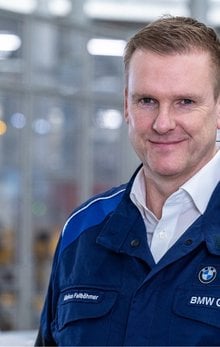
"Our battery cells have a diameter of 46 mm and we use it in two different heights. One is 95 mm and the other 120 mm," says Dr Markus Fallböhmer, Senior Vice President Battery Production, BMW.
18 March
The Future is NEUTRAL operates the first Individual System (IS) in France for the end-of-life management of Renault Group Electric Vehicles Batteries. Founded in 2022, The Future is NEUTRAL's majority shareholder is Renault Group.
Already operating the IS for the management of end-of-life vehicles for 15 automotive brands in France, The Future is NEUTRAL now also manages the end-of-life of batteries.
According to the World Resources Institute, end-of-life EV batteries are classified as hazardous waste in the US and elsewhere due to hazardous components.
Batteries that are left in landfills leech toxic chemicals that pollute the environment, which can expose nearby communities and workers to severe health risks.
17 March
Hyundai has announced the release of a fully driverless robotaxi service in Las Vegas at the end of 2026, together with Motional, an autonomous driving venture.
Motional has developed an end-to-end autonomous driving system based on AI and machine learning.
Motional’s approach blends safety compliance with AI-driven software evolution ensuring that technology maturity is matched by operational readiness.
The all-electric IONIQ 5 robotaxi is produced at Hyundai Motor Group Innovation Centre in Singapore.
The robotaxi has more than 30 sensors, cameras, radars and lidar. These sensors provide robust 360-degree perception, high-resolution images and ultra-long range detection of objects for safe autonomous operation in diverse driving environments.






Executives
Dr. Markus Fallböhmer
Bereichsleiter Produktion Hochvoltspeicher, Energiemodul