
Electric Freightway: Inside GRIDSERVE's eHGV Charging Hubs
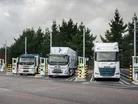
Since opening the UK's first all-electric charging forecourt in 2020, GRIDSERVE has grown a network of more than 1,500 charging bays.
The company has moved beyond cars as part of its Electric Freightway project, opening two of the UK’s first public eHGV charging hubs.
Located in Baldock and Exeter, this project is part of the UK Government-backed ZEHID programme, funded by the Department of Transport and delivered with Innovate UK.
“This is a proud day for the Electric Freightway and indeed for the UK,” says Sam Clarke, Head of the Electric Freightway programme at GRIDSERVE.
“This is the start of a nationwide network for electric trucks as we support the decarbonization of the largest vehicles in road transport.”
Want to learn more about EV infrastructure? Join Sam and other EV leaders at Sustainability LIVE: The Net Zero Summit on 4 and 5 March at the QEII Centre in London.
HGVs in the UK
HGVs are just a small portion of vehicles on UK roads, but are responsible for transporting goods across the country.
In 2023, they were responsible for 18.2 million tonnes of greenhouse gas emissions, or 16% of those of the domestic transport sector, according to the Department for Transport.
More than 500,000 HGVs were licensed in the country in 2024 and just 988 of these were zero emission.
However, these 988 HGVs represent a 34% increase from 2023.
The ZEHID programme
GRIDSERVE's eHGV charging hubs are part of the government's ZEHID programme, short for Zero Emission HGV and Infrastructure Demonstrator.
This programme is backed by around £200m (US$272m) in funding from the Department for Transport and delivered in partnership with Innovate UK.

It aims to deploy around 350 of the heaviest battery-electric and hydrogen fuel cell vehicles on UK roads alongside funding and supporting more than 70 public and depot-based infrastructure installations by 2030.
From 2024 to 2026, the programme aims to build critical charging and refuelling infrastructure.
The second phase, from 2026 to 2031, will see real-world trials of zero-emission HGVs.
All EV leaders should attend:
- Sustainability LIVE: The Net Zero Summit, featuring EV LIVE - QEII Centre, London, 4-5 March 2026
- Sustainability LIVE: The US Summit - Navy Pier, Chicago, 21-22 April 2026
Co-located with Procurement & Supply Chain LIVE, these events bring together Chief Sustainability Officers, Chief Procurement Officers and senior decision-makers to discuss the strategies building the future.
Book your tickets online today with group discounts available.
Project Electric Freightway
The £100m (US$136m) Electric Freightway project will run until 2030 with a fleet of eHGVs on the roads supported by a network of charging infrastructure at motorway service areas and commercial depot charging stations.
In total, around 200 chargers capable of delivering 350 kW will be installed.
This new public charging infrastructure will be supplied by 100% net zero energy.
GRIDSERVE is this project's lead partner among more than 30 other companies., developing, delivering and operating the eHGV charging hubs at motorway service areas and managing infrastructure installations at commercial depots.
The project's principal partner is Hitachi Zero Carbon and the hauliers and operators involved include Amazon UK Services, Kuehne + Nagel, Royal Mail and Maritime Transport.
Location partners of the project include Nissan Motor Manufacturing, Motor Hospitality and British Land Company.
Its OEM partners are DAF Trucks, Renault Trucks UK and Volvo Trucks UK.
GRIDSERVE's work on this project has brought high-power chargers to places where trucks already stop, with a total of 10 eHGV charging bays across the two opened locations.
Daniel Kunkel, GRIDSERVE’s CEO, explains: “Electric freight isn’t some distant future concept anymore, it’s a live, operational reality.
"The same company that gave us the Electric Highway for cars is now doing the same thing for trucks.”
Company portals

Executives

Daniel Kunkel
CEO
Sam Clarke
Head of eHGV